Yet as much as I begrudge the time that I could be spending working on my project and feeling less like I'm going to expire from a heart attack at any moment, I had some fun this week. I covered two classes for my friend Amy on Thursday at the Ambler campus, which is 20 minutes from my house and a world away from the downtown campus--it was like a cute, miniaturized version of Fairfield (really miniaturized, really; I couldn't help but think of what these kids were missing out on versus the main campus). Her first class was an Arts of the Western World, and the kids were...mouthy, verging on disrespectful. There were like three different conversations going on during my lecture--in a small class of only 25 or so. Once or twice I asked them to be quiet, but it's hard to be authoritative when you're basically a substitute teacher. It didn't bother me much, though, for that same reason--they're not my students, and the other kids did seem interested. One girl asked me after class what else I teach, and expressed interest in my Heritage survey next semester because "you seem to actually know what you're talking about." Um, OK--that was an awkward compliment, because was she suggesting that Amy--whose lectures notes I was using, mind you--doesn't?
The second class was much more awesome--it was a class on mythology in art, and I was handling the early Renaissance, so Botticelli, Pollaiuolo, etc. The class was smaller and had many more adult students, and everyone was so eager to participate: they knew the myths in question, they had pertinent observations, questions, etc. A teacher's dream, in other words. Everyone has the most fun with this painting, Botticelli's Venus and Mars, which probably decorated a piece of furniture like a chest in early Renaissance Florence:

Mars has passed out after sex and Venus is looking at him like That's it? What the hell kind of god are you? Five hundred years later and some things haven't changed. Also, imagine how pissed Mars is going to be when that satyr blow the conch shell in his ear (Venus probably put them up to it). After class, several of the students complimented me on the lecture and told me they really enjoyed it, which hey, it's always really nice to hear, especially when these aren't even your own students and are thus clearly not sucking up (unlike the girl who came up to me after class once, pointedly complimented my green coat, and then asked for an extension on her paper. Brown-nosing fail.)
Thursday night, there was a lecture on campus that I had been grumbling about having to attend, but it turned out to be really great. The speaker was Jonathan Lopez, who wrote a book called The Man Who Made Vermeers about the Dutch forger Hans van Meegeren. He was arrested by the Dutch government in 1945 on charges of collaborating with the Nazis, since he had sold Hermann Goering, the number two man in Germany, a priceless Vermeer, Christ and the Adulteress. In order to evade that extremely serious charge, van Meegeren admitted that he hadn't sold Goering anything priceless--it was his own forgery. It later turned out that he'd been forging Vermeers for years, and they had been accepted by art historians and curators around the world, including the National Gallery of Art in DC. His forgeries even included the Supper at Emmaus that was considered, at the time, to be Vermeer's masterpiece.
But the real fascination of this story is not so much that van Meegeren was able to produce forged Vermeers that fooled everyone; it's that the Vermeers he produced look nothing like real Vermeers. For example, these two paintings are legitimate Vermeers, the Geographer and the Girl with the Red Hat:

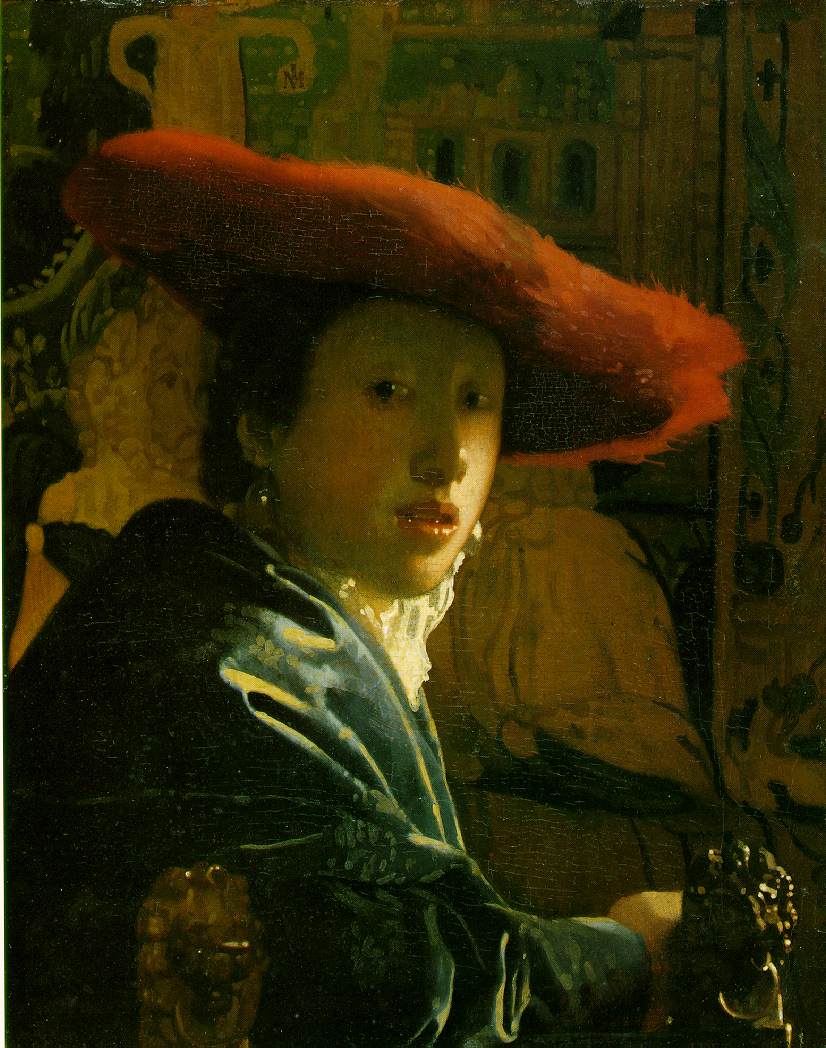
This is van Meegeren's Supper at Emmaus:

Not for a second would anyone today think that the same artist painted that third image as the other two, and yet this fooled everyone. Lopez' most interesting argument was that fakes rely on subliminal references to contemporary culture that make the picture oddly resonant to the viewer and thus more likely to accept it; however, after a few decades (he suggested 40 years is the timeline) the power of those contemporary references has faded, leaving people surprised that anyone could have been tricked all those years ago. In the case of this painting, Lopez traced its relationship to the style of volkisch painting being promoted in Nazi Germany, of which the Dutch van Meegerem was a huge supporter (he sent Hitler a note in 1942 thanking him for doing such a good job. Seriously. It was in Lopez' slideshow), as well as the resemblance between the facial physiognomy of Christ here and Albrecht Durer's famous Self Portrait:
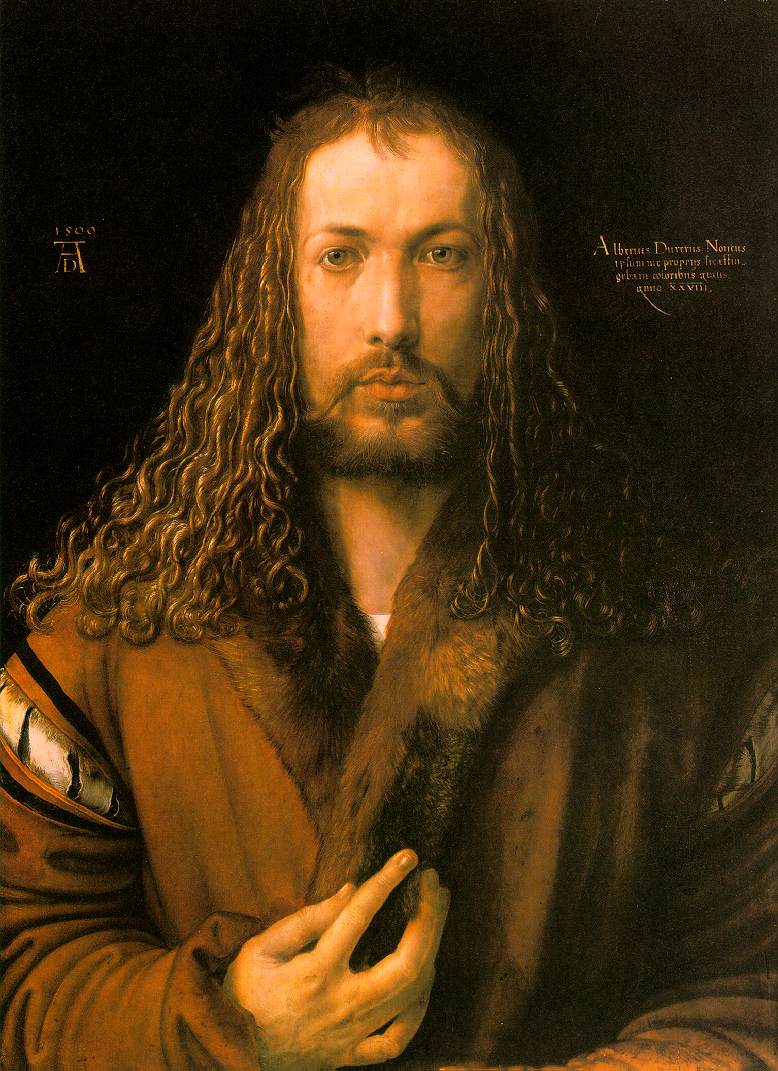 Durer was enthusiastically held up as the paragon of "good" German art by the Nazis, and they had specifically identified his physiognomy as the "ideal" Germanic face. Thus, by incorporating those elements into his completely fake painting, van Meegerem made it subtly more attractive to his contemporaries, who were already "used to" seeing paintings that looked like this.
This is only a small fraction of Lopez' argument, both about this painting and about van Meegeren's forgeries in general, but it was really fascinating to listen to.


