Sean's going to get quite the Christmas surprise in a few hours. Last night I bought us tickets to Turkey. May 9-19th, Constantinople, here we come!!!
Saturday, December 25, 2010
Merry Christmas!
Sean and I went to bed around 2am last night, and I meant to set the alarm for 10 so I could get 8 hours of sleep, but instead I set it for 8am. Waaaay too early. However, the alarm is across the room, so there's not even the option of whacking it and going back to sleep. So I'm up! I'm switching between the Christmas Story and Christmas Vacation, though, so it's not a total loss.
Tuesday, December 14, 2010
Hm
So, I just finished reading Swann's Way (which my friend Amy had dared me, last week, to do by tomorrow; I may not have finished grading even half of the students' papers like I'd planned, but I accomplished something!).
I liked the second half less than the first. The theme of obsessive love crops up again, but we've moved from the young narrator to Charles Swann of the title, and from maternal love to the more amorous kind. This part of the book tells the story of Swann's love affair with Odette, a woman of the demi-monde who has almost nothing to recommend her to Swann except the picture of her that he's created in his head, to which he stubbornly clings despite mounting evidence of her sordid background and lax morals (including bisexuality). Along the way he gives up his friends and his interests in order to join her at her lower social and intellectual level, believing that this kind of sacrifice only proves how much he loves her. His idea of "love" is disturbingly immature and delusional. He acknowledges that he gets absolutely no enjoyment out of his actual meetings with his mistress, but he's in a constant state of anxiety and passion whenever he's not with her. She treats him like crap, cheats on him, and still he supports her with money and slavish devotion, even as he recognizes her low worth and almost looks forward to the day when he'll be free of loving her. Woof.
All this takes place in dense, searching prose, that traces over and over Swann's thousand inconstancies--his brief flare-ups of independence and his desire to escape her, followed inevitably by the resurgence of his belief in her goodness and beauty (again, despite his repeated acknowledgement that she's not really very pretty, and, at one point, his astonished realization at seeing a picture of her earlier in their relationship that she's gotten worse-looking over time!). Being that deep in someone's head for that long (two hundred pages or so) gets old pretty quickly, especially when you don't like them, and I don't like Swann, just like I didn't like the narrator. I kind of wanted to slap, him, actually, and tell him to get a damned job or something--anything but mope around Paris being cuckolded! For example, when he thinks of his desire to visit the Netherlands so he can finally finish an essay he's writing on Vermeer (the only sign of occupation of any sort of this wealthy member of the French bourgeoisie), he quickly realizes that not only can he never, ever leave Paris while Odette is there, he can't even go while she's gone on one of her many trips without him (trips that he's paid for, but which she takes with other men), just in case she might come back early. Seriously. It's that level of pathetic-ness.
By the end of it (and I acknowledge, I was reading far less intently by this point), he's pretty much gotten over his love for her, but he's still obsessed with her. As you find out in the book's final section, though (something that's apparently supposed to be a big reveal but which I knew already thanks to an overview of the novel) the woman he ended up marrying, of whom the narrator's parents disapproved, turns out to be Odette herself. According to what I've read, the second volume explains that he was able to marry her once he no longer loved her. Oh, and he's still obsessed with her, even though he doesn't love her and cheats on her. Yay!
The young narrator, back again, embarks in the final pages on an obsessive crush on their daughter, Gilberte, that follows in many ways the caprices of Swann's passion for Odette--the obsessive need to see her, the belief that any moment she's going to proclaim her love, the near-stalking. Arghhh. Proust's men are so stupid! No, that's wrong, his women are stupid too, we're just not treated to their self-absorbed interior monologues for 462 pages. Any desire I had to read the remaining parts was dimmed when I read that a lot of the rest of it is about, you guessed it, the narrator's obsessive affairs with women! Apparently, in one part that is fittingly entitled "The Captive," he keeps a young woman, Albertine, prisoner in his Paris mansion. Oh, holy Jesus. I am not putting myself through that, no thank you.
Many books can be easily enjoyed on your own, without needing to talk about them with other people, but Swann's Way is one that I think is probably best read in the context of a seminar or book group, with a chance to bring out, through discussion with other people, themes and ideas that my own reading might have passed over. Looking at other people's discussions of Swann's Way online reminded me that this is not a book to be glossed easily, and is undoubtedly one that would repay a closer re-reading, but honestly? I'm just not interested enough to attempt it.
At any rate, I did like the last lines, which return again to the theme of memory and how it can neither recreate nor recapture the past:
"The places we have known do not belong only to the world of space on which we map them for our own convenience. None of them was ever more than a thin slice, held between the contiguous impressions that composed our life at that time; the memory of a particular image is but regret for a particular moment; and houses, roads, avenues are as fugitive, alas, as the years."
Adieu, Proust!
Sunday, December 12, 2010
Reading Swann's Way
The first volume of Proust's epic novel has been on my "to read" list for quite a while. Sara's boyfriend Zach is a Proust aficionado, going so far as to have a quote from the author tattooed on his arm (note to self: ask what the quote actually says), and while I was visiting their apartment last weekend I looked at his bookshelf-worth of Proust and decided it was finally time to give it a try. He assured me that if I read the first one I'd want to read all of them. He also opined that it's the greatest work of fiction ever written.
There's an incredible amount of feeling in this book, and by that I mean that the young narrator, who is a semi-autobiographical reflection of Proust himself, is incredibly sensitive to beauty in the world around him. Sometimes it made me feel like I must be a little bit of a dull block not to be able to share this absolute, over-powering sense of presence within nature, to be able to lose myself for hours, as he claims to be able to do, in contemplating the play of sunlight over the slates of a distant church steeple, or a carpet of buttercups in a meadow. I admire things like that, too, but clearly not to this depth. At other times, however, the extended, rambling passages in which the narrator goes into ecstasies over some kind of flower or another were frankly a little much, and I skipped forward.
I'm halfway through Swann's Way now, and while I can't say that I agree with either assessment, I don't have a terribly strong opinion about it yet; or rather, I should say that I have a bunch of small opinions, but not a generalized opinion of the whole book. I was certainly surprised to find it fairly readable, though; when a thing reaches 1.5 million words and seven volumes and yet still insists on being called a single novel, you expect that there are going to be all manner of strange, impenetrable digressions. Well, digressions there certainly are, but they're musing, melancholy, and philosophical rather than indigestible. I was expecting stream-of-consciousness writing in the manner of Joyce, I suppose, and have been pleasantly surprised on that score.
There's an incredible amount of feeling in this book, and by that I mean that the young narrator, who is a semi-autobiographical reflection of Proust himself, is incredibly sensitive to beauty in the world around him. Sometimes it made me feel like I must be a little bit of a dull block not to be able to share this absolute, over-powering sense of presence within nature, to be able to lose myself for hours, as he claims to be able to do, in contemplating the play of sunlight over the slates of a distant church steeple, or a carpet of buttercups in a meadow. I admire things like that, too, but clearly not to this depth. At other times, however, the extended, rambling passages in which the narrator goes into ecstasies over some kind of flower or another were frankly a little much, and I skipped forward.
I had a vague idea that this was a work of fiction without a real plot, a novel turned inward, on the memories and feelings of its narrator. In that sense it reminds me of Montaigne, who wrote "I myself am the subject of my essays." Proust has an incredible facility with language (and I'm reading the old translation, not the Modern Library one that Zach recommended, which wasn't available in the local library), and so even though there's nothing much happening, I'm interested to see where he's going to go next, what scene or character he's going to sketch vividly in just a few paragraphs. I dog-eared the page with the following passage, which deals with the book's prominent theme of memory--in this case, a memory of the steeple of the church in Combray, the town he knew from his childhood:
"And so even to-day if, in a large provincial town, or in a quarter of Paris which I do not know very well, a passer-by who is "putting me on the right road" shows me in the distance, as a point to aim at, some hospital belfry or convent steeple lifting the peak of its ecclesiastical cap at the corner of the street which I am to take, my memory need only find in it some dim resemblance to that dear and vanished outline, and the passer-by, should he turn round to make sure that I have not gone astray, may be amazed to see me still standing there, oblivious of the walk I had planned or take or the place where I was obliged to call, gazing at the steeple for hours on end, motionless, trying to remember, feeling deep within myself a tract of soil reclaimed from the waters of the Lethe slowly drying until the buildings rise on it again; and then no doubt, and then more anxiously than when, just now, I asked him to direct me, I seek my way again, I turn a corner...but...the goal is in my heart..."
I do have certain negative feelings toward the novel, though. I'm not sure I really like this narrator,this sort-of-Proust-child. Sensitive he may be, but he's also neurotic and self-obsessed. The first section of the novel (the individual volumes themselves even have queer internal structures) focuses around his recollections of his inability to sleep alone as a child, and his obsession with his mother coming in to give him a goodnight kiss before he faced the darkness--to the extent that he was willing to undertake an elaborate plot to lure his mother upstairs on one of the occasions she remained at the dinner table rather than come up to see him. It's difficult to describe here the level of pathological obsession that this kid seems to have with his mother kissing him goodnight; on nights when he knows she won't come up, because they have guests or for another reason, he's plunged into utter despair for hours preceding his bedtime. As in, he says that he wishes he were dead rather than go to sleep without her kissing him. What? It's not clear exactly how old the narrator is supposed to be at this point, and this is terribly gendered, but I can't help it: man the fuck up.
His twisted attitude toward women is expressed obliquely elsewhere; he notes offhand, for example, that you can never trust your mistress, even when you are inflamed with passion, the way you can trust your mother:
"...one has doubts of them even at the moment when one believes in them, and never can possess their hearts as I used to receive, in a kiss, my mother's heart, whole and entire, without qualm or reservation, without the smallest residue of an intention that was not for me alone."
Now, I know that children are selfish, but this to me smacks of a self-involvement verging on solipsism; perhaps because it echoed an earlier passage I took issue with. The narrator, wandering in a wood near Combray, is so overcome with his love of the place that he desires nothing so much as to meet a local peasant girl in order to understand, through her (and implicitly, through having sex with her) its beauty more completely:
"...to wander thus among the woods of Roussainville without a peasant-girl to embrace was to see those woods and yet know nothing of their secret treasure, their deep-hidden beauty. That girl...was to me herself a plant of local growth, and one whose structure would enable me to get closer...to the intimate savor of the country."
This really irritated me, because he sees this girl not as an actual individual with feelings but as a fantasy-object onto which he could project his own desires. She's a tool and not a person--no matter how poetically it's all phrased. Of course, it doesn't help that he goes immediately on to talk about being at:
"that period of life when one has not yet separated the fact of this sensual pleasure from the various women in whose company one has tasted it, when one has not yet reduced it to a general idea which makes one regard them thenceforward as the interchangeable instruments of a pleasure that is always the same." So women are structures and instruments, not people? Nice.
These reservations notwithstanding, I'm glad to be reading it, if only for its importance in the general literary canon. I still refuse to read Joyce, though. On principle! I'm still scarred from my high school attempts to read Portrait of the Author, also known as the only time I BSed my way through an English exam.
Thursday, December 09, 2010
Finish Line!
OK, I'm not 100% done with the semester quite yet; I still have to hand in my paper to Dr. Braddock and grade AWW papers and then the exam on the 17th, but at least classes are over! This semester was more stressful than others, for some reason, and I'm grateful that it's done. I like to think I carried everything off well...except for that online archival translation class, which, let's be honest, I definitely let fall by the wayside when I got overwhelmed with my project for the Caravaggio class. Oh well. I'm not a genius at reading archives, so what?

He's exactly the kind of dog I can take to immediately: totally non-aggressive, doesn't bark, doesn't enthusiastically jump on you in a manner that I always perceive as semi-threatening, loves to cuddle, soft ears...the works. I actually threw a tennis ball for him for the better part of an hour after Sara and Zach left on Sunday morning, which is saying something, because a) I find dog-drool-covered toys disgusting, and b) it freaks me out to have to get near their teeth to get the toy away from them.
I was in New York this past weekend, where I stayed at Sara and Zach's apartment, with their adorable new dog Oscar:

He's exactly the kind of dog I can take to immediately: totally non-aggressive, doesn't bark, doesn't enthusiastically jump on you in a manner that I always perceive as semi-threatening, loves to cuddle, soft ears...the works. I actually threw a tennis ball for him for the better part of an hour after Sara and Zach left on Sunday morning, which is saying something, because a) I find dog-drool-covered toys disgusting, and b) it freaks me out to have to get near their teeth to get the toy away from them.
Saturday night, we went with Heather to see Peter Greenaway's Last Supper project at the Park Ave Armory. I have mixed feelings about it. On the one hand, it was really cool to see a digital reproduction of Leonardo's masterpiece, projected into a space that duplicated the size and scale of the actual refectory at Santa Maria delle Grazie (which I'm not sure when I'll get around to visiting, if ever). Also awesome was the way Greenaway used digital rendering to turn the flat scene into something that seemed, briefly, three-dimensional; the entire scene would go dark, and then lights would play around the figures, making them seem almost to be moving and breathing in the dim light, or he would highlight just the feet, or the hands. I know part of his goal is to make the viewer look at a masterpiece in detail, instead of just absorbing it all at one go, and I felt that was successful. (There's a bit of video here, but it's really not the coolest parts.)
Once this little light show completed after 15 minutes or so and began to loop, though, it sort of lost its flavor. A NYTimes review complained that it lacked any kind of crescendo, although knowing even just a little bit of Greenaway's weirdness (we watched one of his films, The Draughtsman's Contract, during the Rome program) I'm not too surprised.
The odder thing was that despite the event being billed as his Last Supper project, they also threw in his work with Veronese's massive Wedding at Cana, which he projected onto the wall of the church of S. Giorgio in Venice, where it used to hang before Napoleon's soldiers cut it down and took it to France.

This project was much less successful than the Last Supper bit. One reason might be that it's just not as much of a hyper-familiar piece as Leonardo's, even if it is a beautiful spectacle. Greenaway seems to be fascinated by the sheer number of figures present (I forget the number, but maybe 150?) so repeatedly, he would show the scene with numbers superimposed over every single figure. That got old quickly. He also made up dialogue, mostly snarky, for many of the figures, but that veered from amusing to cheesy. Finally, there was an unnecessary voice-over at the beginning about theories that the Wedding at Cana was really Jesus' own wedding to Mary Magdalen, and that that's why Veronese showed him at the center and the married couple off to the left. Now, Veronese had already gotten in trouble with the Inquisition for painting a rowdy Last Supper that featured a bunch of unsavory characters (he wiggled out by re-naming it Supper in the House of Levi). If he'd really painted anything that could be interpreted as mildly heretical in a painting hanging in the biggest church in Venice, don't you think the Inquisition might have taken note? It was unnecessary and made me less interested in the rest of the project.
The Times review called this show, overall, a "dud," and I would almost be tempted to agree, if not for the experience of feeling like I really was standing in that refectory looking up at Leonardo's painting. That was definitely worth it.
On Sunday, I got to check out Heather's new apartment in Carroll Gardens. Her subway stop is elevated, so you get a beautiful view of the Manhattan skyline in one direction, and the Statue of Liberty in the other. The apartment had a lot of light, which is not something I generally associate with urban dwellings, and the neighborhood was really cool--a bunch of (expensive) vintage and antique shops, a couple of Italian markets, a brunch place with delicious, delicious bacon (There was a lot of red meat-eating this weekend. I regret nothing.) One of the vintage stores, where Heather admired a necklace that turned out to cost $275, also sold old timey candy, which we agreed was a good way to make people feel they could come in and poke around without that awkward "I'm totally not going to buy anything" feeling you sometimes get in small shops. (Of course, it can also lead to one friend saying "I can't afford anything, I'm unemployed...maybe I'll get a Sugar Daddy," and the other friend saying "Oh, do they have those?" and then realizing that her friend meant the "wealthy older man" variety and not the candy variety. But I did come out of there with a Sugar Daddy.) Heather really seemed to light up in her new surroundings, which was great. She also just got a three-month position with MacMillan, the publishing company, another sign of new beginnings.
After New York it was off to Connecticut. My wonderful mother-in-law picked me up from the train station in New Haven and whisked me off to her house for dinner, then dropped me off with Jen at a parking lot in Rocky Hill. My sister, wearing pajamas, naturally, ordered me to drive her car. Ah, sisters. We actually shared her bed that night, which was a little weird, since we haven't done that in, oh, more than a decade? Everything was fine, though, until I woke up at 6:15 to Jen yelling "Bob, do you want my cat?" I really have no idea what her damage is. When I asked her later why she thought she had to ask me that right then, when I was sleeping, when it was 6:15 in the morning, she just shrugged and said "I dunno." On the plus side, I got to cuddle with the other cat she wasn't trying to foist onto to me, Sapphire. I'd forgotten that she purrs like a freight train.
There was quite a lot of hustle and bustle, squabbling, yelling, you name it, involved in getting Jen to Hartford for the swearing in. My sister can be insane at the best of times, and she was definitely worked up that morning. More than once I wanted to choke her. It's just a natural reaction to us being in close quarters for any length of time, I'm afraid. We were joined by her boyfriend, Vinny, with whom she was celebrating a year's anniversary, together with my aunt and cousin, our nosy former neighbor Mrs. Long, one of Jen's friends, and Monica's mom, since Monica herself couldn't be there. After the swearing-in Jen dragged us to her office to meet her coworkers, and from there we went to Dom's. My mom's picture was hanging up at the waitress station, and Joanne and the other waitresses who knew us were there. I even ran into Mrs. Caruso, the secretary from St. Gabriel's. She was really friendly, but she asked me, rather presumptuously (even if I didn't think of that until later) if I was married; obviously I could say yes, but later I wondered, "How many people at 25 would be able to say yes to that? How many people would even ask that of someone they haven't seen since they were 14?") Then she asked me if I had kids! Maybe she thought I was a lot older than I am; I don't know. I am proud of what Jen and I have accomplished, though; her road has been a lot harder than mine, and I'm really impressed by how well she's done.
The odder thing was that despite the event being billed as his Last Supper project, they also threw in his work with Veronese's massive Wedding at Cana, which he projected onto the wall of the church of S. Giorgio in Venice, where it used to hang before Napoleon's soldiers cut it down and took it to France.
This project was much less successful than the Last Supper bit. One reason might be that it's just not as much of a hyper-familiar piece as Leonardo's, even if it is a beautiful spectacle. Greenaway seems to be fascinated by the sheer number of figures present (I forget the number, but maybe 150?) so repeatedly, he would show the scene with numbers superimposed over every single figure. That got old quickly. He also made up dialogue, mostly snarky, for many of the figures, but that veered from amusing to cheesy. Finally, there was an unnecessary voice-over at the beginning about theories that the Wedding at Cana was really Jesus' own wedding to Mary Magdalen, and that that's why Veronese showed him at the center and the married couple off to the left. Now, Veronese had already gotten in trouble with the Inquisition for painting a rowdy Last Supper that featured a bunch of unsavory characters (he wiggled out by re-naming it Supper in the House of Levi). If he'd really painted anything that could be interpreted as mildly heretical in a painting hanging in the biggest church in Venice, don't you think the Inquisition might have taken note? It was unnecessary and made me less interested in the rest of the project.
The Times review called this show, overall, a "dud," and I would almost be tempted to agree, if not for the experience of feeling like I really was standing in that refectory looking up at Leonardo's painting. That was definitely worth it.
On Sunday, I got to check out Heather's new apartment in Carroll Gardens. Her subway stop is elevated, so you get a beautiful view of the Manhattan skyline in one direction, and the Statue of Liberty in the other. The apartment had a lot of light, which is not something I generally associate with urban dwellings, and the neighborhood was really cool--a bunch of (expensive) vintage and antique shops, a couple of Italian markets, a brunch place with delicious, delicious bacon (There was a lot of red meat-eating this weekend. I regret nothing.) One of the vintage stores, where Heather admired a necklace that turned out to cost $275, also sold old timey candy, which we agreed was a good way to make people feel they could come in and poke around without that awkward "I'm totally not going to buy anything" feeling you sometimes get in small shops. (Of course, it can also lead to one friend saying "I can't afford anything, I'm unemployed...maybe I'll get a Sugar Daddy," and the other friend saying "Oh, do they have those?" and then realizing that her friend meant the "wealthy older man" variety and not the candy variety. But I did come out of there with a Sugar Daddy.) Heather really seemed to light up in her new surroundings, which was great. She also just got a three-month position with MacMillan, the publishing company, another sign of new beginnings.
After New York it was off to Connecticut. My wonderful mother-in-law picked me up from the train station in New Haven and whisked me off to her house for dinner, then dropped me off with Jen at a parking lot in Rocky Hill. My sister, wearing pajamas, naturally, ordered me to drive her car. Ah, sisters. We actually shared her bed that night, which was a little weird, since we haven't done that in, oh, more than a decade? Everything was fine, though, until I woke up at 6:15 to Jen yelling "Bob, do you want my cat?" I really have no idea what her damage is. When I asked her later why she thought she had to ask me that right then, when I was sleeping, when it was 6:15 in the morning, she just shrugged and said "I dunno." On the plus side, I got to cuddle with the other cat she wasn't trying to foist onto to me, Sapphire. I'd forgotten that she purrs like a freight train.
There was quite a lot of hustle and bustle, squabbling, yelling, you name it, involved in getting Jen to Hartford for the swearing in. My sister can be insane at the best of times, and she was definitely worked up that morning. More than once I wanted to choke her. It's just a natural reaction to us being in close quarters for any length of time, I'm afraid. We were joined by her boyfriend, Vinny, with whom she was celebrating a year's anniversary, together with my aunt and cousin, our nosy former neighbor Mrs. Long, one of Jen's friends, and Monica's mom, since Monica herself couldn't be there. After the swearing-in Jen dragged us to her office to meet her coworkers, and from there we went to Dom's. My mom's picture was hanging up at the waitress station, and Joanne and the other waitresses who knew us were there. I even ran into Mrs. Caruso, the secretary from St. Gabriel's. She was really friendly, but she asked me, rather presumptuously (even if I didn't think of that until later) if I was married; obviously I could say yes, but later I wondered, "How many people at 25 would be able to say yes to that? How many people would even ask that of someone they haven't seen since they were 14?") Then she asked me if I had kids! Maybe she thought I was a lot older than I am; I don't know. I am proud of what Jen and I have accomplished, though; her road has been a lot harder than mine, and I'm really impressed by how well she's done.
Thursday, December 02, 2010
Success!


And a gallery for Nicolas Regnier:

I was lucky enough to find high-resolution images of the Caravaggio show that is currently on in Rome right now, to which I simply added the paintings I wanted to use for my exhibition. It did require some fiddling and duplication of parts of the images to have enough correctly sized frames, and I'm not skilled enough with Photoshop to know how to get rid of the line that pretty clearly divides the Saraceni image down the center, but hey, not bad for a first-timer, I'd say. When I saw Dr. Cooper smiling and nodding the first few minutes, I was like, "Ok, this is not going to crash and burn, awesome sauce!" One of classmates told me after that my presentations are always a pleasure just to listen to and that this one was even more enjoyable, which was a really nice compliment. Not too shabby for a project that I started working on, oh, three weeks ago!
I ended up making two exhibition posters, actually, using the one above, Carlo Saraceni's alluring Judith with the Head of Holofernes for my first slide, and the one below, Nicolas Regnier's Carnival Scene, for the last:

Friday, November 19, 2010
Busy, Busy
The hectic end-of-semester rush is here, and I'm really feeling it this time. I sort of put off-slash-kept changing my mind on what to do for my project for Dr. Cooper's class, with the result that I finished my two other projects early and now have to throw myself into this 110% before my presentation on December 1. Naturally, with Thanksgiving coming up, I have even less time, plus there's so much else going on around this time of year, so it's been rather stressful.
Yet as much as I begrudge the time that I could be spending working on my project and feeling less like I'm going to expire from a heart attack at any moment, I had some fun this week. I covered two classes for my friend Amy on Thursday at the Ambler campus, which is 20 minutes from my house and a world away from the downtown campus--it was like a cute, miniaturized version of Fairfield (really miniaturized, really; I couldn't help but think of what these kids were missing out on versus the main campus). Her first class was an Arts of the Western World, and the kids were...mouthy, verging on disrespectful. There were like three different conversations going on during my lecture--in a small class of only 25 or so. Once or twice I asked them to be quiet, but it's hard to be authoritative when you're basically a substitute teacher. It didn't bother me much, though, for that same reason--they're not my students, and the other kids did seem interested. One girl asked me after class what else I teach, and expressed interest in my Heritage survey next semester because "you seem to actually know what you're talking about." Um, OK--that was an awkward compliment, because was she suggesting that Amy--whose lectures notes I was using, mind you--doesn't?
The second class was much more awesome--it was a class on mythology in art, and I was handling the early Renaissance, so Botticelli, Pollaiuolo, etc. The class was smaller and had many more adult students, and everyone was so eager to participate: they knew the myths in question, they had pertinent observations, questions, etc. A teacher's dream, in other words. Everyone has the most fun with this painting, Botticelli's Venus and Mars, which probably decorated a piece of furniture like a chest in early Renaissance Florence:

Mars has passed out after sex and Venus is looking at him like That's it? What the hell kind of god are you? Five hundred years later and some things haven't changed. Also, imagine how pissed Mars is going to be when that satyr blow the conch shell in his ear (Venus probably put them up to it). After class, several of the students complimented me on the lecture and told me they really enjoyed it, which hey, it's always really nice to hear, especially when these aren't even your own students and are thus clearly not sucking up (unlike the girl who came up to me after class once, pointedly complimented my green coat, and then asked for an extension on her paper. Brown-nosing fail.)
Thursday night, there was a lecture on campus that I had been grumbling about having to attend, but it turned out to be really great. The speaker was Jonathan Lopez, who wrote a book called The Man Who Made Vermeers about the Dutch forger Hans van Meegeren. He was arrested by the Dutch government in 1945 on charges of collaborating with the Nazis, since he had sold Hermann Goering, the number two man in Germany, a priceless Vermeer, Christ and the Adulteress. In order to evade that extremely serious charge, van Meegeren admitted that he hadn't sold Goering anything priceless--it was his own forgery. It later turned out that he'd been forging Vermeers for years, and they had been accepted by art historians and curators around the world, including the National Gallery of Art in DC. His forgeries even included the Supper at Emmaus that was considered, at the time, to be Vermeer's masterpiece.
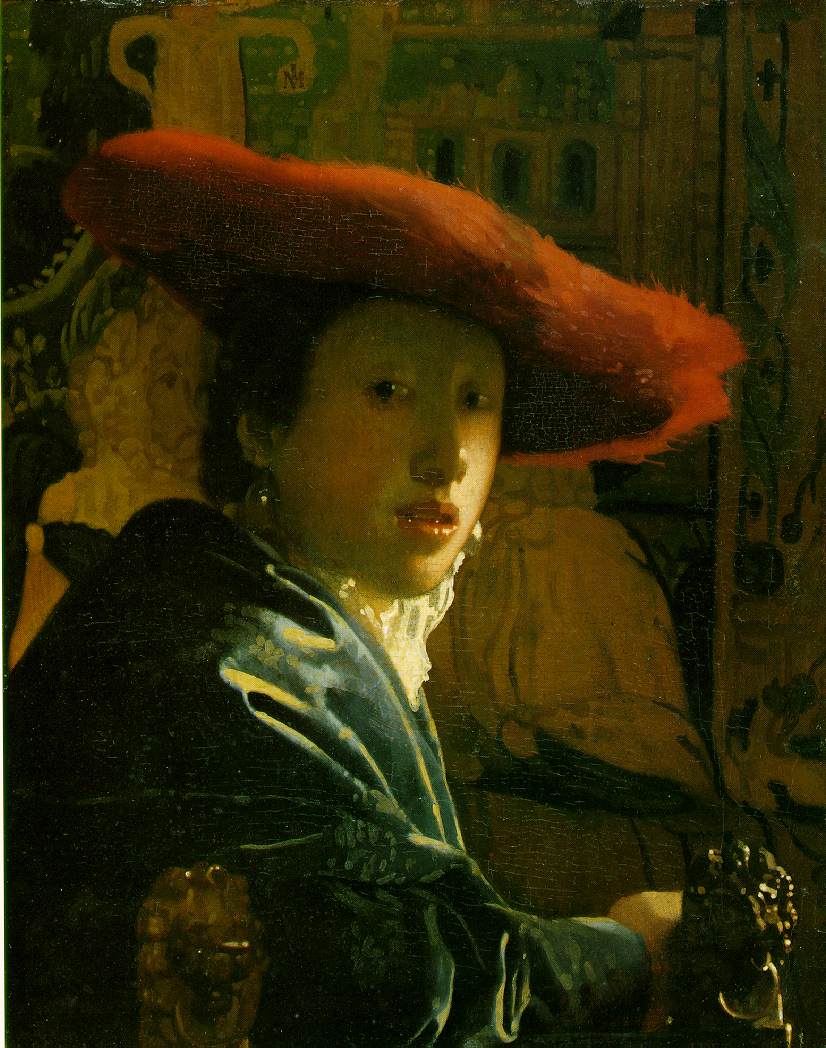
But the real fascination of this story is not so much that van Meegeren was able to produce forged Vermeers that fooled everyone; it's that the Vermeers he produced look nothing like real Vermeers. For example, these two paintings are legitimate Vermeers, the Geographer and the Girl with the Red Hat:

This is van Meegeren's Supper at Emmaus:

Not for a second would anyone today think that the same artist painted that third image as the other two, and yet this fooled everyone. Lopez' most interesting argument was that fakes rely on subliminal references to contemporary culture that make the picture oddly resonant to the viewer and thus more likely to accept it; however, after a few decades (he suggested 40 years is the timeline) the power of those contemporary references has faded, leaving people surprised that anyone could have been tricked all those years ago. In the case of this painting, Lopez traced its relationship to the style of volkisch painting being promoted in Nazi Germany, of which the Dutch van Meegerem was a huge supporter (he sent Hitler a note in 1942 thanking him for doing such a good job. Seriously. It was in Lopez' slideshow), as well as the resemblance between the facial physiognomy of Christ here and Albrecht Durer's famous Self Portrait:
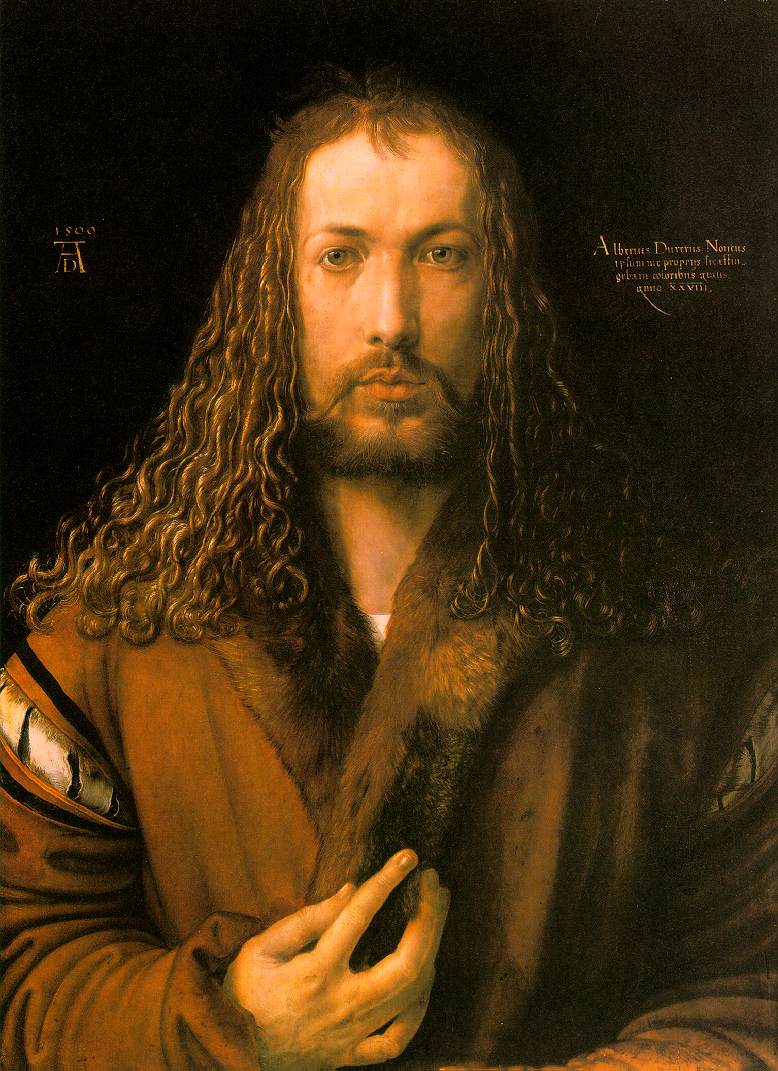 Durer was enthusiastically held up as the paragon of "good" German art by the Nazis, and they had specifically identified his physiognomy as the "ideal" Germanic face. Thus, by incorporating those elements into his completely fake painting, van Meegerem made it subtly more attractive to his contemporaries, who were already "used to" seeing paintings that looked like this.
This is only a small fraction of Lopez' argument, both about this painting and about van Meegeren's forgeries in general, but it was really fascinating to listen to.
Yet as much as I begrudge the time that I could be spending working on my project and feeling less like I'm going to expire from a heart attack at any moment, I had some fun this week. I covered two classes for my friend Amy on Thursday at the Ambler campus, which is 20 minutes from my house and a world away from the downtown campus--it was like a cute, miniaturized version of Fairfield (really miniaturized, really; I couldn't help but think of what these kids were missing out on versus the main campus). Her first class was an Arts of the Western World, and the kids were...mouthy, verging on disrespectful. There were like three different conversations going on during my lecture--in a small class of only 25 or so. Once or twice I asked them to be quiet, but it's hard to be authoritative when you're basically a substitute teacher. It didn't bother me much, though, for that same reason--they're not my students, and the other kids did seem interested. One girl asked me after class what else I teach, and expressed interest in my Heritage survey next semester because "you seem to actually know what you're talking about." Um, OK--that was an awkward compliment, because was she suggesting that Amy--whose lectures notes I was using, mind you--doesn't?
The second class was much more awesome--it was a class on mythology in art, and I was handling the early Renaissance, so Botticelli, Pollaiuolo, etc. The class was smaller and had many more adult students, and everyone was so eager to participate: they knew the myths in question, they had pertinent observations, questions, etc. A teacher's dream, in other words. Everyone has the most fun with this painting, Botticelli's Venus and Mars, which probably decorated a piece of furniture like a chest in early Renaissance Florence:
Mars has passed out after sex and Venus is looking at him like That's it? What the hell kind of god are you? Five hundred years later and some things haven't changed. Also, imagine how pissed Mars is going to be when that satyr blow the conch shell in his ear (Venus probably put them up to it). After class, several of the students complimented me on the lecture and told me they really enjoyed it, which hey, it's always really nice to hear, especially when these aren't even your own students and are thus clearly not sucking up (unlike the girl who came up to me after class once, pointedly complimented my green coat, and then asked for an extension on her paper. Brown-nosing fail.)
Thursday night, there was a lecture on campus that I had been grumbling about having to attend, but it turned out to be really great. The speaker was Jonathan Lopez, who wrote a book called The Man Who Made Vermeers about the Dutch forger Hans van Meegeren. He was arrested by the Dutch government in 1945 on charges of collaborating with the Nazis, since he had sold Hermann Goering, the number two man in Germany, a priceless Vermeer, Christ and the Adulteress. In order to evade that extremely serious charge, van Meegeren admitted that he hadn't sold Goering anything priceless--it was his own forgery. It later turned out that he'd been forging Vermeers for years, and they had been accepted by art historians and curators around the world, including the National Gallery of Art in DC. His forgeries even included the Supper at Emmaus that was considered, at the time, to be Vermeer's masterpiece.
But the real fascination of this story is not so much that van Meegeren was able to produce forged Vermeers that fooled everyone; it's that the Vermeers he produced look nothing like real Vermeers. For example, these two paintings are legitimate Vermeers, the Geographer and the Girl with the Red Hat:
This is van Meegeren's Supper at Emmaus:
Not for a second would anyone today think that the same artist painted that third image as the other two, and yet this fooled everyone. Lopez' most interesting argument was that fakes rely on subliminal references to contemporary culture that make the picture oddly resonant to the viewer and thus more likely to accept it; however, after a few decades (he suggested 40 years is the timeline) the power of those contemporary references has faded, leaving people surprised that anyone could have been tricked all those years ago. In the case of this painting, Lopez traced its relationship to the style of volkisch painting being promoted in Nazi Germany, of which the Dutch van Meegerem was a huge supporter (he sent Hitler a note in 1942 thanking him for doing such a good job. Seriously. It was in Lopez' slideshow), as well as the resemblance between the facial physiognomy of Christ here and Albrecht Durer's famous Self Portrait:
Durer was enthusiastically held up as the paragon of "good" German art by the Nazis, and they had specifically identified his physiognomy as the "ideal" Germanic face. Thus, by incorporating those elements into his completely fake painting, van Meegerem made it subtly more attractive to his contemporaries, who were already "used to" seeing paintings that looked like this.This is only a small fraction of Lopez' argument, both about this painting and about van Meegeren's forgeries in general, but it was really fascinating to listen to.
Thursday, November 11, 2010
Still Life
 Raphaelle Peale, Blackberries, c. 1813, oil on panel
One of my classmates gave her presentation in our Caravaggio seminar on the relationship between Caravaggio and 19th century American still life painters. Typically the American still life tradition has been linked to the long history of Dutch still lifes, but my friend discovered that the Pennsylvania Academy of Fine Arts had exhibited a still life attributed to Caravaggio in 1811, just before Raphaelle Peale and others began to paint the kind of tenebristic composition shown above.
The location of the painting itself is a mystery, but the fact that it was identified as a Caravaggio in the early 19th century, when his reputation was basically in the gutter (he wouldn't be catapulted to the megastardom through which we know him today until a historic exhibition in Milan in 1951) suggests that it was a secure attribution. Only one independent still life by Caravaggio is known today, this incredibly illusionistic work of 1599 (it's like you could reach out and stroke the wicker of that basket!):

Yet we know he painted more of them--and one of them, it seems, found its way to Philadelphia and had an impact on Peale, a member of a prominent family of Philadelphia artists.
Now, I'm not usually a big fan of still life. Caravaggio's marvelous little picture is an exception to this rule, on account of its general awesomeness, but in general, blech. Dutch still life, in particular, is probably the genre of Western art I like least.
 Clara Peeters, Still Life with Flowers, 17th c.
I know they're full of hyper-specific symbolism and they constitute warnings about vanitas, but I just find them so. damn. ugly. My friend knows all this, so she was teasing me in advance about how I would probably be bored to tears by her paper, but to my surprise, I really enjoyed not only her argument, but the images as well. Don't Peale's blackberries look good enough to eat? She also showed this late 16th century drawing of irises by a Florentine naturalist named Ligozzi (not technically a still life, but it's still something I'm not usually intrigued by):
The location of the painting itself is a mystery, but the fact that it was identified as a Caravaggio in the early 19th century, when his reputation was basically in the gutter (he wouldn't be catapulted to the megastardom through which we know him today until a historic exhibition in Milan in 1951) suggests that it was a secure attribution. Only one independent still life by Caravaggio is known today, this incredibly illusionistic work of 1599 (it's like you could reach out and stroke the wicker of that basket!):
Yet we know he painted more of them--and one of them, it seems, found its way to Philadelphia and had an impact on Peale, a member of a prominent family of Philadelphia artists.
Now, I'm not usually a big fan of still life. Caravaggio's marvelous little picture is an exception to this rule, on account of its general awesomeness, but in general, blech. Dutch still life, in particular, is probably the genre of Western art I like least.
Clara Peeters, Still Life with Flowers, 17th c.I know they're full of hyper-specific symbolism and they constitute warnings about vanitas, but I just find them so. damn. ugly. My friend knows all this, so she was teasing me in advance about how I would probably be bored to tears by her paper, but to my surprise, I really enjoyed not only her argument, but the images as well. Don't Peale's blackberries look good enough to eat? She also showed this late 16th century drawing of irises by a Florentine naturalist named Ligozzi (not technically a still life, but it's still something I'm not usually intrigued by):

I have a fondness for irises, so this really struck me as lovely. However, I remain resolute in my hatred of Dutch still life. Gah.
Tuesday, November 02, 2010
Fun with Professors
A few weeks ago Jasmine, Agnes and I went to see "Never Let Me Go" at the Ritz in Old City, where tickets are $6 for students. One of our professors, Dr. Bolman, happens to live in that neighborhood. Now, Dr. Bolman has always had something of a fearsome reputation as the professor who puts the fear of God into undergraduates and graduates alike, the professor whose constant watchword is "professionalism." Not a professor who gets buddy-buddy with her students by any means. Thus, I was a little surprised to get an email from her saying that if we went to another movie at the Ritz before she left for Egypt on December 1, she'd like to invite us to her apartment beforehand.
Apparently, the recent retirement of her mentor at Bryn Mawr caused her to re-evaluate her attitude toward students (well, not all students. A few select students. Us, basically.) She told us last night that her mentor never showed any fondness for her students until they completed their PhDs, at which point she suddenly started signing her emails "Love, Dale." Dr. Bolman told us she had this epiphany where she realized she didn't have to be like that and didn't want to be. So, voila--we got to visit Dr. Bolman's fabulous apartment.
The building was old, completely modernized except for some cool features like the 20-foot ceilings, exposed wooden beams, and original dark wood floors (the nails had square heads, which was interesting). She has more books than I have ever seen in anyone's personal collection. Her office was lined with bookcases, her hallway was lined with bookcases, the living room was lined with bookcases! It was pretty incredible. It was also decorated in a really cool fashion, which I don't think I can really describe, and her furniture rocked. Like, a ridiculously comfortable leather couch that also incorporated a chaise longue--from Ikea, although I never would have thought so (apparently they do have 'higher end' furniture." There's an odd sense of intimacy in being in a professor's home and putting your coat and bag down in her bedroom, or using the bathroom and seeing all her makeup. Jasmine and I agreed on the ride home that at first it was a little bit awkward, because we weren't quite sure what to say (we wound up talking about school, naturally). Luckily there was wine to drink and cheese to nibble on.
We had invited her to join us for the movie, and she accepted, so off we went in the cold to see "Hereafter," which we were expecting to be a sad movie. Dr. Bolman announced herself as a crier and made us promise that if she cried we wouldn't tell anyone, but in the end it wasn't really a crying kind of movie. There were some sad bits, but none too heart-wrenching, and the ending was happy in a contrived sort of way. I don't think I'd really recommend it to anyone else, it was fine, but nothing special. Anyway, after that we went to a Persian restaurant near Dr. Bolman's apartment for takeout, to which she treated us, using her "voice of command," as she called it, on Jasmine when she seemed about to insist on contributing. That was pretty hilarious, especially the way Jasmine immediately obeyed and sat down. Then we went back to her apartment to eat. As we were getting plates I noticed that among the items on her fridge were two magnets of Bella and Edward from Twilight. WTF?
We did wind up having an interesting discussion about psychics and talking to the dead (Matt Damon plays one in the film). I asked if the others would consult one. Dr. Bolman told us that twenty years or so, she used to visit a psychic regularly! (I managed not to let my mouth fall open, but it was a close thing). She said that she was looking for some kind of confirmation that there was something else out there, some other dimension, and she would go to this woman who claimed to read auras and tell you vague things about your future. She could also tell you things about people in photographs if you brought them in; Dr. Bolman said she was thoroughly convinced by this woman's ability to accurately describe people she had never met and only seen in a photograph, and that the vague predictions about her future always came true, but she realized ultimately that it was drawing too much of her attention and money, so she stopped going.
Jasmine said she wasn't sure if she would consult a psychic, Agnes said probably not. I told them about how my mom consulted a psychic on her birthday once and was quite convinced--the person told her she saw a red-headed woman who wanted to know if my mom was still angry at her (she was) and a large man with a breathing problem (my dad had sleep apnea), who wanted her to know that he was OK. I said that I wasn't sure either, partially because I'm a skeptic and I don't believe in life after death, and partially because I don't feel the burning need to talk to my parents. I mean, what would I say to them? I miss you? Duh. And what would I want to hear back, that they're fine, that they're proud of me, etc? Since I don't believe in an afterlife of any variety, I'm not concerned about them being "fine," and I know they were proud of me. I think trying to communicate with them, even if it were possible, would just be more painful than it'd be worth. Jen, on the other hand, would leap at the chance, I'm sure (in fact, I'm shocked she's never done it). However, even though I don't believe in the afterlife, I'm not completely skeptical about psychics. I mean, we only use a fraction of our brain power, so who's to say what could be possible for people who can somehow access the rest? After all, we only perceive time as completely linear; maybe they do catch glimpses of the future.
We also wound up discussing our favorite works of art. I was surprised to learn that Dr. Bolman's favorite was Simone Martini's Annunciation in the Uffizi (she's a Byzantinist/Coptic specialist, so I thought it'd be something there). Agnes' favorite was a painting from the Waddi Natrun site she's worked on in Egypt. Jasmine's favorites are two Saint Cecilias: Raphael's painting, and Stefano Maderno's statue. I had serious trouble thinking of favorites; in the end I said El Greco's View of Toledo, and Canova's statue of Pauline Bonaparte in the Borghese.
Anyway, we had a really fun time last night. I heart Dr. Bolman!
Apparently, the recent retirement of her mentor at Bryn Mawr caused her to re-evaluate her attitude toward students (well, not all students. A few select students. Us, basically.) She told us last night that her mentor never showed any fondness for her students until they completed their PhDs, at which point she suddenly started signing her emails "Love, Dale." Dr. Bolman told us she had this epiphany where she realized she didn't have to be like that and didn't want to be. So, voila--we got to visit Dr. Bolman's fabulous apartment.
The building was old, completely modernized except for some cool features like the 20-foot ceilings, exposed wooden beams, and original dark wood floors (the nails had square heads, which was interesting). She has more books than I have ever seen in anyone's personal collection. Her office was lined with bookcases, her hallway was lined with bookcases, the living room was lined with bookcases! It was pretty incredible. It was also decorated in a really cool fashion, which I don't think I can really describe, and her furniture rocked. Like, a ridiculously comfortable leather couch that also incorporated a chaise longue--from Ikea, although I never would have thought so (apparently they do have 'higher end' furniture." There's an odd sense of intimacy in being in a professor's home and putting your coat and bag down in her bedroom, or using the bathroom and seeing all her makeup. Jasmine and I agreed on the ride home that at first it was a little bit awkward, because we weren't quite sure what to say (we wound up talking about school, naturally). Luckily there was wine to drink and cheese to nibble on.
We had invited her to join us for the movie, and she accepted, so off we went in the cold to see "Hereafter," which we were expecting to be a sad movie. Dr. Bolman announced herself as a crier and made us promise that if she cried we wouldn't tell anyone, but in the end it wasn't really a crying kind of movie. There were some sad bits, but none too heart-wrenching, and the ending was happy in a contrived sort of way. I don't think I'd really recommend it to anyone else, it was fine, but nothing special. Anyway, after that we went to a Persian restaurant near Dr. Bolman's apartment for takeout, to which she treated us, using her "voice of command," as she called it, on Jasmine when she seemed about to insist on contributing. That was pretty hilarious, especially the way Jasmine immediately obeyed and sat down. Then we went back to her apartment to eat. As we were getting plates I noticed that among the items on her fridge were two magnets of Bella and Edward from Twilight. WTF?
We did wind up having an interesting discussion about psychics and talking to the dead (Matt Damon plays one in the film). I asked if the others would consult one. Dr. Bolman told us that twenty years or so, she used to visit a psychic regularly! (I managed not to let my mouth fall open, but it was a close thing). She said that she was looking for some kind of confirmation that there was something else out there, some other dimension, and she would go to this woman who claimed to read auras and tell you vague things about your future. She could also tell you things about people in photographs if you brought them in; Dr. Bolman said she was thoroughly convinced by this woman's ability to accurately describe people she had never met and only seen in a photograph, and that the vague predictions about her future always came true, but she realized ultimately that it was drawing too much of her attention and money, so she stopped going.
Jasmine said she wasn't sure if she would consult a psychic, Agnes said probably not. I told them about how my mom consulted a psychic on her birthday once and was quite convinced--the person told her she saw a red-headed woman who wanted to know if my mom was still angry at her (she was) and a large man with a breathing problem (my dad had sleep apnea), who wanted her to know that he was OK. I said that I wasn't sure either, partially because I'm a skeptic and I don't believe in life after death, and partially because I don't feel the burning need to talk to my parents. I mean, what would I say to them? I miss you? Duh. And what would I want to hear back, that they're fine, that they're proud of me, etc? Since I don't believe in an afterlife of any variety, I'm not concerned about them being "fine," and I know they were proud of me. I think trying to communicate with them, even if it were possible, would just be more painful than it'd be worth. Jen, on the other hand, would leap at the chance, I'm sure (in fact, I'm shocked she's never done it). However, even though I don't believe in the afterlife, I'm not completely skeptical about psychics. I mean, we only use a fraction of our brain power, so who's to say what could be possible for people who can somehow access the rest? After all, we only perceive time as completely linear; maybe they do catch glimpses of the future.
We also wound up discussing our favorite works of art. I was surprised to learn that Dr. Bolman's favorite was Simone Martini's Annunciation in the Uffizi (she's a Byzantinist/Coptic specialist, so I thought it'd be something there). Agnes' favorite was a painting from the Waddi Natrun site she's worked on in Egypt. Jasmine's favorites are two Saint Cecilias: Raphael's painting, and Stefano Maderno's statue. I had serious trouble thinking of favorites; in the end I said El Greco's View of Toledo, and Canova's statue of Pauline Bonaparte in the Borghese.
Anyway, we had a really fun time last night. I heart Dr. Bolman!
Sunday, October 31, 2010
Fun with Transcription
I'm participating in an online course right now on transcribing Renaissance archival documents through the Medici Archive Project in Rome. I have zero experience with archives, but archive research is a large part of the "history" part of art history, so I'll be doing it someday. I was rather unprepared for Renaissance conventions of orthograhy, spelling, punctuation, you name it. The first obstacle is the handwriting itself, which can be absolutely impenetrable, like this week's supplemental document:

I have no idea what this says. In the entire thing, I could pick out the words "della sposa," that's all. Luckily, I'm not alone, no one else in the class can figure it out either. A lot of the other participants clearly have experience reading older hands and know a lot more about Italian grammar than I do, which is a little intimidating.
The chief difficulty in transcribing these documents is the number of abbreviatons that people used--there are a lot, and while some follow fairly standard conventions, others seem just totally random. Some are easy to figure out; if you see a document start off V. S. Ecc.a, that's Vostra Signoria Eccellenza, your excellent lordship. Final vowels are routinely left off words and indicated by a little dash of superscript, so governar' is "governare," etc. More random is how they'll omit letters within a word: de'a is "detta," and dima'davano is "dimandavano." I mean, you're already writing out the whole word, what's one more letter? They will also use multiple abbreviations for long words, so gra'diss.a is "grandissima." And then sometimes I just have no idea, like last week, when the writer of the document identified herself as Caterina Picc.i, and everyone else was like "oh, Caterina Piccolomini, of course!" and I was like wait, what?
There is a little book on medieval and Renaissance document abbreviations that lists some of the most common ones, which is especially key when it's not an abbreviation but rather a symbol, or an entire word indicated by a single letter with some marks above it. Unfortunately, there were no real standards for this back then. Then you have to factor in the legibility, how educated the person was, where in Italy they were from (all the different cities in Italy marked a different day as the beginning of the New Year, so March 25 1547 in Venice is still 1546 in Naples), and, basically, whether they could put a coherent sentence together. It's pretty daunting, and I can't imagine being left on my own to look at this stuff in an archive.
That said, this week's main document was fairly easy to decipher; the writing is very legible, the abbreviations are pretty standard, and I could immediately figure out what they're talking about (that can be a real help in figuring out an otherwise ambiguous word). It's a news report from Antwerp on the current political situation in England, namely the Prayerbook Rebellion of 1549.

I've transcribed it and translated it, since now we're doing a round-robin thing where everyone contributes a line. My favorite is this line:
Che il conte di Varvich et il signor Gray quali erano destinati per capitani quali della armata contro lo scozzesi erano mandate con una parte della gente per impedire le vettovaglie, et havevano intercetti alcuni che venivano in aiuto di detto populo, et fatti morire alcuni preti.
That the count of Warwick and Mr Gray, who were intended to be captains of the armada against the Scots, were sent with a part of the army to impede their supply lines, and they have intercepted some who came to aid those people, and have killed some priests.
Those Protesants did not fuck around...

I have no idea what this says. In the entire thing, I could pick out the words "della sposa," that's all. Luckily, I'm not alone, no one else in the class can figure it out either. A lot of the other participants clearly have experience reading older hands and know a lot more about Italian grammar than I do, which is a little intimidating.
The chief difficulty in transcribing these documents is the number of abbreviatons that people used--there are a lot, and while some follow fairly standard conventions, others seem just totally random. Some are easy to figure out; if you see a document start off V. S. Ecc.a, that's Vostra Signoria Eccellenza, your excellent lordship. Final vowels are routinely left off words and indicated by a little dash of superscript, so governar' is "governare," etc. More random is how they'll omit letters within a word: de'a is "detta," and dima'davano is "dimandavano." I mean, you're already writing out the whole word, what's one more letter? They will also use multiple abbreviations for long words, so gra'diss.a is "grandissima." And then sometimes I just have no idea, like last week, when the writer of the document identified herself as Caterina Picc.i, and everyone else was like "oh, Caterina Piccolomini, of course!" and I was like wait, what?
There is a little book on medieval and Renaissance document abbreviations that lists some of the most common ones, which is especially key when it's not an abbreviation but rather a symbol, or an entire word indicated by a single letter with some marks above it. Unfortunately, there were no real standards for this back then. Then you have to factor in the legibility, how educated the person was, where in Italy they were from (all the different cities in Italy marked a different day as the beginning of the New Year, so March 25 1547 in Venice is still 1546 in Naples), and, basically, whether they could put a coherent sentence together. It's pretty daunting, and I can't imagine being left on my own to look at this stuff in an archive.
That said, this week's main document was fairly easy to decipher; the writing is very legible, the abbreviations are pretty standard, and I could immediately figure out what they're talking about (that can be a real help in figuring out an otherwise ambiguous word). It's a news report from Antwerp on the current political situation in England, namely the Prayerbook Rebellion of 1549.

I've transcribed it and translated it, since now we're doing a round-robin thing where everyone contributes a line. My favorite is this line:
Che il conte di Varvich et il signor Gray quali erano destinati per capitani quali della armata contro lo scozzesi erano mandate con una parte della gente per impedire le vettovaglie, et havevano intercetti alcuni che venivano in aiuto di detto populo, et fatti morire alcuni preti.
That the count of Warwick and Mr Gray, who were intended to be captains of the armada against the Scots, were sent with a part of the army to impede their supply lines, and they have intercepted some who came to aid those people, and have killed some priests.
Those Protesants did not fuck around...
Thursday, October 28, 2010
Post-Script
The vet put Lady Jane to sleep yesterday afternoon. He called me and explained that while he could keep her alive longer, he didn't think it was the humane course of action, especially since he couldn't explain why she was unable to walk and was going downhill so quickly. I was at school by this point, so I'm glad that I'd gotten all cried out in the morning. Of course, I'd told a bunch of people why I was going to be late, so my friends all asked about my new cat, and Dr. Cooper asked if I had a picture, and I had to tell them nope, sorry, false alarm, no new kitty. Sigh.
Wednesday, October 27, 2010

Yesterday I went to the Wissahickon around 9 for a walk and took my camera with me to finally capture some pictures of the gorgeous foliage before it all falls to the ground.

The route I take, between Kitchens Lane and Livezy Lane entrances to the park, has two trail options. The lower trail is down by the river and much more scenic, but it's incredibly rocky and takes maybe 45-50 minutes round trip. You also have to go over Fingerspan Bridge and then down the 100 feet of stone steps, which I haven't been keen on doing lately while they're covered in damp leaves. The upper trail, which is for hikers, bikers, and horses, is less picturesque but faster, probably 30 minutes round-trip, especially if you jog the flatter parts. The high trail has its challenges, though, at least for someone like me who's afraid of heights: three massive concrete pipes that lead you across ravines. In two of the cases, you can easily follow a trail that leads you up and around them, but you have to cross the third if you want to go out to Livezey Lane (actually, there is an alternate route here too, but it takes you out like a quarter-mile up the road, so I don't bother). Naturally, the third is the longest and has the steepest ravine underneath it. Naturally.

Thus, since it freaks me out to cross the pipes even when conditions are totally dry, I've been extra freaked about doing it with damp shoes. Yesterday, however, I decided I was going to take the high trail to Livezy, then walk down the road so I could take the lower trail back to Kitchens, thereby giving me time to snap photos of my favorite vistas. So I braved the third pipe, freaking out all the while, and headed down to the water to take the low trail. While I was down there I noticed a cat lying in the leaves, and went over to introduce myself because, hey, I like to do those things. She was really friendly, and when I pulled my hand away she got up to follow me--and promptly fell over. Then she tried again, and fell again. Uh-oh. I watched her for a few minutes, thinking, "Man, this cat must be dying." Thomas kept falling over right before we took him to be euthanized, so I figured this cat was in the same position.
Of course this had to happen when I was something like two miles away from my car. I decided to hike back, get the car, drive to Livezey Lane and then take the cat to Phyllis' vet in Chestnut Hill. While I was headed back--thinking of how that cat almost definitely had fleas, and how I didn't even have a blanket in my car, nor my credit card or license, and should I go home to get something and come back and run the risk she'd drag herself into the woods--it did cross my mind that I could just leave her there and let nature take its course; it costs $90 to have a cat euthanized, but nothing to let it die on its own in the woods. Then I thought of my mom, and if she would ever leave a helpless sick animal to fend for itself, especially a cat, and I knew she wouldn't, not even if she was only helping it to be killed humanely.
Anyway, I made it back to the car and sped over to Livezey. The only thing I had in the car was an inflatable air mattress in the trunk, so I wrapped the cat in that once I'd successfully manhandled her into the car. She was clearly frightened, but so gentle: she didn't hiss or try to bite me. I took her to the vet fully expecting they would just tell me she needed to be put to sleep, but instead an hour later they told me they wanted to run a whole barrage of tests on her to see if she might just be weak and dehydrated. Expected cost: $190. I said OK, and went home. The vet called later with good news: her bloodwork looked good, she didn't have FIV or leukemia, she was just weak and anemic. He said they'd give her some steroids and antibiotics, and her problem walking might clear up on its own once she was stronger. He wanted to keep her overnight but told me I could take her home in the morning.
Phyllis and I talked about it last night, and decided that since this cat had clearly 'chosen' us, we should adopt her. We decided to give her a trial run for a few weeks on the front porch, and see if her walking issues went away. Phyllis asked if I'd thought of a name, and I lied and said no, but of course I had--I remembered she had a cute little grey face, so I thought we could call her Lady Jane Grey. (As I discovered today, only her head was grey; the rest of her was "blue cream," a diluted form of the tortoiseshell gene.) Luckily we still had most of Thomas' things, but I went to the store this morning and bought wet and dry catfood as well. Then I went to the vet.
I should have known something was up by the look on the receptionist's face when I said I was there to pick up the stray. She told me the vet tech would be out shortly "to talk." That is exactly they do to you at hospitals when someone is dead or dying, but I was so confident in what the vet himself had told me that I just shrugged. Then the technician came out, and told me that the cat had gone sharply downhill overnight. She could barely eat, and couldn't stand at all. They told me they needed to keep her for observation, but that it's likely she'll need to be euthanized anyway. I went in the back to see her, and even without any medical expertise I could tell how bad she was; she couldn't even raise her head to look at me when I petted her, whereas yesterday she could move around and try to follow me. I went back out front and signed the euthanization release form: if the vet decides her condition is too bad, they'll put her to sleep today, without waiting for me. I wouldn't be able to come back till tomorrow, and there's no reason to make her suffer.
Everyone was really nice and sympathetic, especially since they agreed she's a really sweet cat. I know it's better for her to be put to sleep painlessly than to die out there in the woods, alone, but I still found myself crying all the way home. It's my own fault for getting my hopes up, I know: I named her in my head, and set up the dishes and litterbox on the porch, and bought a couple different kinds of wet food because I didn't know what she'd like. The vet just seemed to optimistic about her chances yesterday that I thought it was a done deal. I was looking forward to having a cat again, but now it doesn't look like that will happen, or if it does, it won't be Lady Jane.
Today is a nasty, rainy day. I'm glad I decided to go to the park yesterday, when I don't normally go on Tuesdays. I'm glad I decided to swing down by the water when I would normally have just turned around on the high trail. I'm glad she's somewhere warm and comfortable, and that there will be people with her when they put her down. I'm just so sad that I couldn't take her home with me. And now I'm crying again, and I have to leave for the train. Dammit!
Sunday, October 10, 2010
Fun Times with the Spouse
Sean's here, yay! He got in really late on Thursday, and then came to school with me on Friday, He went to gallery talk given by Dr. Silk on communism and the arts in the 1950s while I was teaching my section, and then we went to get lunch from one of the trucks on campus. The proprietor, a very friendly old man with a Greek accent, must have seen our rings and seen us kissing, because he congratulated us on 'committing to each other for life,' and then told us about his grandchildren and showed us pictures on his cell phone before handing over our (delicious!) wraps. That was some good feta, I tell you. I think I've made a new friend.
Friday afternoon into the evening we volunteered to help Dr. Bolman set up for the reception she was hosting for the attendees of the Byzantine Studies Conference at Penn to celebrate her exhibition on the conservation of the Red and White monasteries. This is a pretty big deal, not only because the exhibition is awesome and is going to travel to museums around the world, but because it raises Temple's profile in the Byzantine studies community considerably. Many of the people who came told her they'd never been to Temple before but were quite impressed, and I know that the vast and delectable spread, catered by Whole Foods, was a crowd-pleaser. One guy actually took a photo of one of the tables before leaving. We didn't leave until 8:30, and Dr. Bolman insisted we all take a bottle of wine (with strict instructions not to tell anyone she gave it to us) as well as whatever food we could carry; Sean and I opted for an entire fruit tray, because that was some of the best-tasting fruit I've had in recent memory. She was really pleased that so many non-medieval students were there to help out, and she was doubly pleased that I managed to volunteer my husband at the same time!
Saturday morning we went to the PMA, where I had an appointment with the art librarian, and then walked around the collections for a couple of hours. We were both pretty exhausted from the night before, so we weren't at the optimal level of enthusiasm for a museum tour, but it was still nice. Generally in museums we wander around arguing about what pictures we would and wouldn't hang in our future house. Sean's always worried that I would want some "nightmarish" modern art piece. We did agree on a few select items, including Frederic Edwin Church's Pichincha, but we disagreed on a lot more! Oh, and he tried to embarrass me in the Abstract Expressionist room by making fun of the art. Sigh.
Last night we went to see Henry V at the Sedgwick Theatre, down the street from my house. It's in a beautiful Art Deco building from the 1920s, and although the interior has been really ravaged by time, there are echoes of the original mural decorations on the walls and ceiling. The actual theater portion of the building was sectioned off a long time ago, so the performance took place in a huge oval-shaped room that was once one of the lobbies (the theater group's website has a picture of the ceiling in this room, with a chandelier and the remains of the painted decoration).
The play was done pretty old-school, with bare stage, largely normal lighting, and almost no props. The costumes ranged from historical (for the foppish French nobles) to recent-historical (WWII uniforms for the soldiers) to contemporary (tuxedos for King Henry's court when they were being formal). Men also played the women's roles--and played them disturbingly well, considering the amount of movement in high heels that was required. The performance was really good, but the play itself was a little odd; immediately after the dramatic victory at Agincourt, the tone switches to comedy with Henry playing a trick on one of his soldiers. Then there's an extended courtship scene at the end between Henry and the daughter of the vanquished French king, which, while funny, made me lean over and whisper to Sean "when did this turn into a romantic comedy?" Then it ended a couple of minutes later on a totally down note, showing the king's future death and the accession of his young son, who would lose everything that his father had just won. It was kind of uneven, but overall extremely enjoyable. Oh, and student tickets were $10! Win.
Friday afternoon into the evening we volunteered to help Dr. Bolman set up for the reception she was hosting for the attendees of the Byzantine Studies Conference at Penn to celebrate her exhibition on the conservation of the Red and White monasteries. This is a pretty big deal, not only because the exhibition is awesome and is going to travel to museums around the world, but because it raises Temple's profile in the Byzantine studies community considerably. Many of the people who came told her they'd never been to Temple before but were quite impressed, and I know that the vast and delectable spread, catered by Whole Foods, was a crowd-pleaser. One guy actually took a photo of one of the tables before leaving. We didn't leave until 8:30, and Dr. Bolman insisted we all take a bottle of wine (with strict instructions not to tell anyone she gave it to us) as well as whatever food we could carry; Sean and I opted for an entire fruit tray, because that was some of the best-tasting fruit I've had in recent memory. She was really pleased that so many non-medieval students were there to help out, and she was doubly pleased that I managed to volunteer my husband at the same time!
Saturday morning we went to the PMA, where I had an appointment with the art librarian, and then walked around the collections for a couple of hours. We were both pretty exhausted from the night before, so we weren't at the optimal level of enthusiasm for a museum tour, but it was still nice. Generally in museums we wander around arguing about what pictures we would and wouldn't hang in our future house. Sean's always worried that I would want some "nightmarish" modern art piece. We did agree on a few select items, including Frederic Edwin Church's Pichincha, but we disagreed on a lot more! Oh, and he tried to embarrass me in the Abstract Expressionist room by making fun of the art. Sigh.
Last night we went to see Henry V at the Sedgwick Theatre, down the street from my house. It's in a beautiful Art Deco building from the 1920s, and although the interior has been really ravaged by time, there are echoes of the original mural decorations on the walls and ceiling. The actual theater portion of the building was sectioned off a long time ago, so the performance took place in a huge oval-shaped room that was once one of the lobbies (the theater group's website has a picture of the ceiling in this room, with a chandelier and the remains of the painted decoration).
The play was done pretty old-school, with bare stage, largely normal lighting, and almost no props. The costumes ranged from historical (for the foppish French nobles) to recent-historical (WWII uniforms for the soldiers) to contemporary (tuxedos for King Henry's court when they were being formal). Men also played the women's roles--and played them disturbingly well, considering the amount of movement in high heels that was required. The performance was really good, but the play itself was a little odd; immediately after the dramatic victory at Agincourt, the tone switches to comedy with Henry playing a trick on one of his soldiers. Then there's an extended courtship scene at the end between Henry and the daughter of the vanquished French king, which, while funny, made me lean over and whisper to Sean "when did this turn into a romantic comedy?" Then it ended a couple of minutes later on a totally down note, showing the king's future death and the accession of his young son, who would lose everything that his father had just won. It was kind of uneven, but overall extremely enjoyable. Oh, and student tickets were $10! Win.
Saturday, September 25, 2010
Semi-Sick Day
The too-rapid change in weather here from seasonably chilly to Indian summer over the past couple of days has wreaked havoc on my sinuses, rendering me sniffly, sneezy, and tired. I went to bed almost immediately after watching the season premiere of Supernatural last night and slept 11 hours, with the help of Sudafed. I've taken the day pills today, but I still feel out of it and tired. I dragged myself to school to get some books so I can stay home today and tomorrow and still have a hope of getting something accomplished. Later. Much later.
In the meantime, I came across this list from 2004 that the BBC compiled of the best-loved novels in Britain. Supposedly they said that the average person has read only six of 100, but I didn't see anything to that effect on their website. Anyway, despite not being British, I thought I would go through and see how many I've read.
1. The Lord of the Rings, JRR Tolkien: LOTR is seriously Britain's number 1 book? Hm. I found them rather dry, actually. This is one instance in which I can say I like the movie version better. (I'm thinking rather snidely of Francis Ford Coppola's maxim as regards the Godfather: "if you want to make a great movie, use a mediocre book.")
2. Pride and Prejudice, Jane Austen: One of my favorite books of all time!
3. His Dark Materials, Philip Pullman: Although a good series, I'm again surprised to see this so high up on the list. Do British people like sci-fi/fantasy a bit more than Americans? I cried so much at the end of the third book.
4. The Hitchhiker's Guide to the Galaxy, Douglas Adams: I read all the Hitchhiker books at one go, after I confiscated Sean's collected works of Douglas Adams when he visited me in Italy in 2006. The first one is of course the best; they get progressively weirder and harder to follow. Adams wasn't much concerned with continuity, I don't think.
5. Harry Potter and the Goblet of Fire, JK Rowling: Need I say anything? Although I do wonder if I will love these books as much when I'm 40 as I did when I was 20. That's not a question I've ever asked myself of something like Pride and Prejudice, which has had the benefit of a few hundred years of popularity.
6. To Kill a Mockingbird, Harper Lee: This book interested me while I was reading it for a summer book list in high school, but once I was done with it I never regarded it with any affection. Perhaps it's time for a re-read.
7. Winnie the Pooh, AA Milne: Um, I've never read it so I guess I can't comment, but...really?
8. Nineteen Eighty-Four, George Orwell: Sean mentioned a plot point from this book on the phone the other night, and I realized quite frankly how little of this book I remember. I read it in high school, and what I chiefly recall was how much of its vocabulary--words like "doublespeak"--I began to notice as having been absorbed into our common speech and writing. Another book I should revisit.
9. The Lion, the Witch and the Wardrobe, CS Lewis: This is the only book of the series I ever read, and that when I was in elementary school, I believe. I never really became attached to it, though I did have a strong desire to try marzipan based on its description in the book (until I saw what it looked like, and no thanks, I do not want fruit-shaped candy)
10. Jane Eyre, Charlotte Brontë: I got this book in Florence and really enjoyed it my first time through, but on successive re-readings I've found myself completely skipping the several hundred pages between Jane's flight from Thornfield and her return to the broken Mr. Rochester. The part about St. John bores me, frankly, and I never liked that the book's last lines are about him. Re-reading has also made me question the relationship between Jane and Rochester, which is unequal in so many respects, and I don't like the way he messes with her head for his own amusement. Also: Charlotte Bronte hated on Jane Austen's books, and she slides in my esteem for that!
11. Catch-22, Joseph Heller: I read this for a class I took on comedy in college, and then I re-read about half of it this past summer. It certainly is black comedy, but I think Heller sort of loses control of it about halfway through. Possibly that was the point. I don't remember.
12. Wuthering Heights, Emily Brontë: Given a choice to hang out with Jane Austen or the Bronte sisters for a day, there would be no contest. They had a rather bleak outlook on life, didn't they? None more so than Emily. I object to anyone who finds Heathcliff a romantic character in the 'dark and brooding' mold. He is an asshole. Plain and simple. People die and lives are miserable because he is an asshole. There's nothing romantic in that.
13. Birdsong, Sebastian Faulks: I'm not sure what this is...
14. Rebecca, Daphne du Maurier: I just read this book this summer. It's a decent thriller, but the plot was probably was much more novel in its day (1938) than it is now. The relationship between the main character (I thought I had forgotten her name, but nope, she's unnamed) and her new husband Max de Winter has a lot of parallels to the Jane/Rochester relationship, and not in a good way. This book is probably better in the film version, because I think the silent creepiness of Mrs. Danvers could be better appreciated visually than it is here.
15. The Catcher in the Rye, JD Salinger: Grumble. I did not love this book when we read it in high school. I found its protagonist irritating. Holden Caulfield is often held forward as epitomizing the struggle of young people to find themselves, but I didn't sympathize with him. Perhaps because I've always always had a fairly good grasp on my own identity? Or do young men find him more sympathetic than girls?
16. The Wind in the Willows, Kenneth Grahame: Well this is embarrassing: I thought I had read this, but it turns out I was thinking of the book Frog and Toad Are Friends. Whoops. That...is probably not considered great literature, since it's like for 5-year-olds. "The Lost Button," anyone?
17. Great Expectations, Charles Dickens: I started to read this once, but never finished it. In fact, the only Dickens I've read in full is a Tale of Two Cities, which I'm always meaning to re-read. I've also read David Copperfield, if you count the Great Illustrated Classics versions...
18. Little Women, Louisa May Alcott: Never read it.
19. Captain Corelli's Mandolin, Louis de Bernieres: Nope.
20. War and Peace, Leo Tolstoy: Another one I started and didn't get into. I read Anna Karenina, though! I should get points for slogging through one Tolstoy at least.
21. Gone with the Wind, Margaret Mitchell: This is a very long book, from what I remember (which is not much, since I got the book from the library when I was a kid after having spent an entire Saturday afternoon on the couch watching the film version).
22. Harry Potter And The Philosopher's Stone, JK Rowling: Love.
23. Harry Potter And The Chamber Of Secrets, JK Rowling: Love.
24. Harry Potter And The Prisoner Of Azkaban, JK Rowling: Love.
25. The Hobbit, JRR Tolkien: Meh. Again, Tolkien just doesn't grab me. And it's not that I don't like fantasy novels; I do, or least I was much more into them at the same age when I read this.
26. Tess Of The D'Urbervilles, Thomas Hardy: No, although I remember Sara reading this when we were in middle school. Also, I frequently mixed it up in my mind with The Hound of the Baskervilles. Yeah, that's a Sherlock Holmes story (another book I re-read this summer).
27. Middlemarch, George Eliot: No.
28. A Prayer For Owen Meany, John Irving: No. I read another of his books, Life According to Garp, on the advice of--believe it or not--Dr. Eliasoph. I didn't really like it.
29. The Grapes Of Wrath, John Steinbeck: Nope.
30. Alice's Adventures In Wonderland, Lewis Carroll: Yes, but meh. This is really one of people's favorite stories? I envision favorite books as something you can return to again and again with renewed enthusiasm. Lewis Carroll, like JM. Barrie, doesn't attract me now like he once might have (but even as a child I wasn't a huge fan, it was a little too absurdist).
31. The Story Of Tracy Beaker, Jacqueline Wilson: I've never heard of this before.
32. One Hundred Years Of Solitude, Gabriel García Márquez: No, but it's on my "read when I have time" list!
33. The Pillars Of The Earth, Ken Follett: I love historical fiction, but I shy away from the kind that spans decades and generations because you know from the outset that your favorite characters are all going to die. That said, I did try to read this, and couldn't get into it, despite many people's assertions that it is the Best Book Ever.
34. David Copperfield, Charles Dickens: yes, via Great Illustrated Classics (along with books like Ivanhoe, Around the World in 80 Days, The Prince and the Pauper...my mom was a big fan of those books!) I'm going to say that I probably didn't get the full effect.
35. Charlie And The Chocolate Factory, Roald Dahl: One of my favorites! Even though it's children's lit, I can come back to this and other Dahl books over and over again. Neither Gene Wilder nor Johnny Depp will ever capture Mr. Wonka for me; I will always picture him as the little goateed man he is in the book's illustrations.
36. Treasure Island, Robert Louis Stevenson: Yes, when I was quite young (meaning it probably wasn't the original version), and I don't remember it. My grandfather used to call me Long John Silver because I was taller than him.
37. A Town Like Alice, Nevil Shute: No.
38. Persuasion, Jane Austen: No, surprisingly enough.
39. Dune, Frank Herbert: No. Greg and his mom were really into this series, though.
40. Emma, Jane Austen: When I first read this book, I disliked the character of Emma immensely; I thought she was a selfish, immature busybody, and I hated her paternalistic attitude towards Harriet. Remarkably, what changed my mind was not the book itself but the recent BBC miniseries (which I happened to be re-watching last night, actually). Romola Garai's Emma is winsomely effervescent and over-eager at the beginning, but she sobers quite a bit by the end after she realizes how mistaken she's been. Rereading the book after watching the series, I was much more impressed by the novel as a whole. Also, I think Clueless is one of the greatest translations of classical literature into modern cinema!
41. Anne Of Green Gables, LM Montgomery: I've loved these books (and the attendant films) since I was a little girl and I think I'll love them when I'm 80. Even though I am, by personality, probably more of a practical Diana Barry than a manic-pixie-dreamgirl like Anne, I love Anne Shirley and the world of Avonlea. Also, Gilbert Blythe is my perfect man (though Sean comes close).
42. Watership Down, Richard Adams: It's a book about rabbits. Honestly, I was expecting a little more. I read this because it was one of Greg's favorite books, and at the end I thought "That was nothing compared to Brian Jacques." His Redwall series, which is set in a medieval Britain populated by anthropomorphic animals, probably wouldn't captivate me quite as much now as it did then, but it was a darn sight more exciting (and insightful) than these rabbits.
43. The Great Gatsby, F Scott Fitzgerald: I must be the only person who didn't have to read this book in high school! By the time I read it, a year or two ago, I'd already read The Beautiful and the Damned, and so knew I liked his writing style. Gatsby brings the tragedy to its close much more swiftly, but his evocation of a particular class, and the individuals in that class, is terrifyingly acute. The world is still full of Daisys and Toms, and probably, sadly, Gatsbys as well.
44. The Count Of Monte Cristo, Alexandre Dumas: Yes, although I don't have a particularly strong recollection of it. I was very into Dumas one summer during college, and I read several of the books about the Three Musketeers plus this one.
45. Brideshead Revisited, Evelyn Waugh: No. This strikes me as one of those books that is very British--boarding school vacations and the old moneyed class, etc. I've read only one Waugh book, Scoop (which I enjoyed) but it was entirely different in subject and tone.
46. Animal Farm, George Orwell: When I first read this I was probably in seventh grade or so, because Jen was reading it for a class in high school. I liked it, although I had no idea that it had an allegorical meaning about socialism and Communism! I remember being very surprised when I found that out, although I can't remember if Jen told me or if it was later.
47. A Christmas Carol, Charles Dickens: Hm, I'm really not sure if I've ever read this, actually. I suppose with the plethora and film and cartoon adaptations it's one of those things you feel completely familiar with without ever having read. I think I'll always associate it most with the Disney version--Scrooge McDuck as his namesake, Goofy as Jakob Marley, and Mickey's son as Tiny Tim. On another note, the Christmas episode of Doctor Who this season is supposed to be related to A Christmas Carol, and since they've already met Charles Dickens, I'm interested to see where they'll take it.
48. Far From The Madding Crowd, Thomas Hardy: No, but we read The Mayor of Casterbridge in high school. Thomas Hardy really knew how to write a depressing story, didn't he?
49. Goodnight Mister Tom, Michelle Magorian: No idea.
50. The Shell Seekers, Rosamunde Pilcher: Nope.
51. The Secret Garden, Frances Hodgson Burnett: Yes (there's quite a bit of children's lit on this list, isn't there?)
52. Of Mice And Men, John Steinbeck: This is such a sad story in the end. Steinbeck and Hardy would have gotten along so well!
53. The Stand, Stephen King: No.
54. Anna Karenina, Leo Tolstoy: This book is about so much more than the figure of Anna herself, but my intense dislike for her colored what I thought of the rest of the book. Her absolute shock at finding out that no, you can't just divorce your husband in 19th-century Moscow and then expect all your society friends to keep treating you the same way when you start running around town with your military boytoy was so irritating! I was eager for her to quit her melodramatic hissy fits and just throw herself under the train already.
55. A Suitable Boy, Vikram Seth: No idea.
56. The BFG, Roald Dahl: Another Dahl book! Yes! BFG was one of my favorite; so favorite, in fact, that I borrowed and lost no less than three successive copies of this book from the Windsor Public Library. I had to work off the cost (what was it, like $4?) in chores for my mother each time.
57. Swallows And Amazons, Arthur Ransome: No idea.
58. Black Beauty, Anna Sewell: I read this, but it was in an easy-reader format when I was in third grade, along with The Little Princess. I wanted a monkey.
59. Artemis Fowl, Eoin Colfer: The first book in this series was quite good, and promised wonderful things that I'm not sure the remainder of the series carried through. I'm sure it suffered by the inevitable comparisons with Harry Potter, especially since the main character, a super-brilliant billionaire's son with a flagrant disregard for all authority, is hardly sympathetic.
60. Crime And Punishment, Fyodor Dostoyevsky: I tried to read this in high school, but I couldn't get all the way through. Is it an unfair assessment to say that Russian literature is just dark?
61. Noughts And Crosses, Malorie Blackman: no idea.
62. Memoirs Of A Geisha, Arthur Golden: What I love most about this book is its evocation of a time and a place that is so far removed from my experience: the exotic elegance of the geisha world. I don't enjoy the last quarter or so as much as I do the rest; in narrative terms, that's where the story has to go, of course, but post-war Gion is just such a sad shadow of its former glory. (Also, the idea that the Chairman has been interested in her since she was what, 11? is just a little too weird for me).
63. A Tale Of Two Cities, Charles Dickens: One day I will re-read this. One day.
64. The Thorn Birds, Colleen McCollough: This is a long book, on the scale of Gone with the Wind. I saw part of the miniseries on TV in high school and found the book at my grandfather's house, but I never got all the way through.
65. Mort, Terry Pratchett: Nope.
66. The Magic Faraway Tree, Enid Blyton: Nope.
67. The Magus, John Fowles: Nope--I've never heard of a bunch of these books!
68. Good Omens, Terry Pratchett and Neil Gaiman: Thi.s is a great book.
69. Guards! Guards!, Terry Pratchett: British people are serious Pratchett fans. Nope.
70. Lord Of The Flies, William Golding: I've always wondered how the events of this book would have played out if it had been a group of girls stranded on the island. Also, has anyone ever figured out why they say "Sucks to your asmar" as an insult?
71. Perfume, Patrick Süskind: No.
72. The Ragged Trousered Philanthropists, Robert Tressell: No.
73. Night Watch, Terry Pratchett: No.
74. Matilda, Roald Dahl: Not my favorite Dahl (where is The Witches on this list?)
75. Bridget Jones's Diary, Helen Fielding: Another book I liked less than its film. The diary format makes you like Bridget less, I think, because she comes off as a bit of a narcissist. Each entry starts off with a tabulation of her weight, number of cigarettes smoked, and number of drinks consumed. By rights I'm shocked she wasn't dead by the end of that book.
76. The Secret History, Donna Tartt: No.
77. The Woman In White, Wilkie Collins: No.
78. Ulysses, James Joyce: Shudder. No.
79. Bleak House, Charles Dickens: No. Jen got this book on Amazon and was surprised to discover it was depressing. Gee, the title was too subtle?
80. Double Act, Jacqueline Wilson: No.
81. The Twits, Roald Dahl: British people love Dahl, I guess.
82. I Capture The Castle, Dodie Smith: No; I saw the movie, and it was very strange.
83. Holes, Louis Sachar: No.
84. Gormenghast, Mervyn Peake: Never heard of it.
85. The God Of Small Things, Arundhati Roy: No.
86. Vicky Angel, Jacqueline Wilson: Never heard of it.
87. Brave New World, Aldous Huxley: Ironically, I read this book for my comedy class, same as Catch-22.
88. Cold Comfort Farm, Stella Gibbons: I saw the movie version of this first, and was a little freaked out by it because I didn't realize it was supposed to be a slightly over-the-top satire. Once I read the book I appreciated it much more.
89. Magician, Raymond E Feist: No.
90. On The Road, Jack Kerouac: Maybe it's because I'm not a man, or because I'm not edgy and interested in trying a lot of drugs to access other planes of consciousness, or...whatever. This book alienated me like three pages in.
91. The Godfather, Mario Puzo: I'm very surprised to see this on here, because it's usually considered a pretty mediocre book, as Coppola would tell you. The structure is different than the movies, because this book starts with Corleone in his youth in Sicily, then documents how he came to the US and rose to power. I don't even remember if Michael plays a role in it. Tommy went to college with a girl who was Puzo's granddaughter; she said all his grandchildren were discouraged from reading his books until they were 18, when he gave them each a complete set.
92. The Clan Of The Cave Bear, Jean M Auel: Hm, I think I read parts of this when I was a kid, but I'm not sure.
93. The Colour Of Magic, Terry Pratchett: No.
94. The Alchemist, Paulo Coelho: Some people talk about this book like it's some kind of gospel. I didn't see that in it at all; it's part fable, part magical realism, yes, but it didn't change my life.
95. Katherine, Anya Seton: Never heard of it.
96. Kane And Abel, Jeffrey Archer: Ditto.
97. Love In The Time Of Cholera, Gabriel García Márquez: No.
98. Girls In Love, Jacqueline Wilson: No.
99. The Princess Diaries, Meg Cabot: I am...very surprised that this is on this list. I did read the book because I liked the movie, and it's a fine example of YA lit, I guess.
100. Midnight's Children, Salman Rushdie: No. I read The Satanic Verses and couldn't quite come to terms with the unorthodox narrative structure; however, I quite enjoyed The Enchantress of Florence.
In the meantime, I came across this list from 2004 that the BBC compiled of the best-loved novels in Britain. Supposedly they said that the average person has read only six of 100, but I didn't see anything to that effect on their website. Anyway, despite not being British, I thought I would go through and see how many I've read.
1. The Lord of the Rings, JRR Tolkien: LOTR is seriously Britain's number 1 book? Hm. I found them rather dry, actually. This is one instance in which I can say I like the movie version better. (I'm thinking rather snidely of Francis Ford Coppola's maxim as regards the Godfather: "if you want to make a great movie, use a mediocre book.")
2. Pride and Prejudice, Jane Austen: One of my favorite books of all time!
3. His Dark Materials, Philip Pullman: Although a good series, I'm again surprised to see this so high up on the list. Do British people like sci-fi/fantasy a bit more than Americans? I cried so much at the end of the third book.
4. The Hitchhiker's Guide to the Galaxy, Douglas Adams: I read all the Hitchhiker books at one go, after I confiscated Sean's collected works of Douglas Adams when he visited me in Italy in 2006. The first one is of course the best; they get progressively weirder and harder to follow. Adams wasn't much concerned with continuity, I don't think.
5. Harry Potter and the Goblet of Fire, JK Rowling: Need I say anything? Although I do wonder if I will love these books as much when I'm 40 as I did when I was 20. That's not a question I've ever asked myself of something like Pride and Prejudice, which has had the benefit of a few hundred years of popularity.
6. To Kill a Mockingbird, Harper Lee: This book interested me while I was reading it for a summer book list in high school, but once I was done with it I never regarded it with any affection. Perhaps it's time for a re-read.
7. Winnie the Pooh, AA Milne: Um, I've never read it so I guess I can't comment, but...really?
8. Nineteen Eighty-Four, George Orwell: Sean mentioned a plot point from this book on the phone the other night, and I realized quite frankly how little of this book I remember. I read it in high school, and what I chiefly recall was how much of its vocabulary--words like "doublespeak"--I began to notice as having been absorbed into our common speech and writing. Another book I should revisit.
9. The Lion, the Witch and the Wardrobe, CS Lewis: This is the only book of the series I ever read, and that when I was in elementary school, I believe. I never really became attached to it, though I did have a strong desire to try marzipan based on its description in the book (until I saw what it looked like, and no thanks, I do not want fruit-shaped candy)
10. Jane Eyre, Charlotte Brontë: I got this book in Florence and really enjoyed it my first time through, but on successive re-readings I've found myself completely skipping the several hundred pages between Jane's flight from Thornfield and her return to the broken Mr. Rochester. The part about St. John bores me, frankly, and I never liked that the book's last lines are about him. Re-reading has also made me question the relationship between Jane and Rochester, which is unequal in so many respects, and I don't like the way he messes with her head for his own amusement. Also: Charlotte Bronte hated on Jane Austen's books, and she slides in my esteem for that!
11. Catch-22, Joseph Heller: I read this for a class I took on comedy in college, and then I re-read about half of it this past summer. It certainly is black comedy, but I think Heller sort of loses control of it about halfway through. Possibly that was the point. I don't remember.
12. Wuthering Heights, Emily Brontë: Given a choice to hang out with Jane Austen or the Bronte sisters for a day, there would be no contest. They had a rather bleak outlook on life, didn't they? None more so than Emily. I object to anyone who finds Heathcliff a romantic character in the 'dark and brooding' mold. He is an asshole. Plain and simple. People die and lives are miserable because he is an asshole. There's nothing romantic in that.
13. Birdsong, Sebastian Faulks: I'm not sure what this is...
14. Rebecca, Daphne du Maurier: I just read this book this summer. It's a decent thriller, but the plot was probably was much more novel in its day (1938) than it is now. The relationship between the main character (I thought I had forgotten her name, but nope, she's unnamed) and her new husband Max de Winter has a lot of parallels to the Jane/Rochester relationship, and not in a good way. This book is probably better in the film version, because I think the silent creepiness of Mrs. Danvers could be better appreciated visually than it is here.
15. The Catcher in the Rye, JD Salinger: Grumble. I did not love this book when we read it in high school. I found its protagonist irritating. Holden Caulfield is often held forward as epitomizing the struggle of young people to find themselves, but I didn't sympathize with him. Perhaps because I've always always had a fairly good grasp on my own identity? Or do young men find him more sympathetic than girls?
16. The Wind in the Willows, Kenneth Grahame: Well this is embarrassing: I thought I had read this, but it turns out I was thinking of the book Frog and Toad Are Friends. Whoops. That...is probably not considered great literature, since it's like for 5-year-olds. "The Lost Button," anyone?
17. Great Expectations, Charles Dickens: I started to read this once, but never finished it. In fact, the only Dickens I've read in full is a Tale of Two Cities, which I'm always meaning to re-read. I've also read David Copperfield, if you count the Great Illustrated Classics versions...
18. Little Women, Louisa May Alcott: Never read it.
19. Captain Corelli's Mandolin, Louis de Bernieres: Nope.
20. War and Peace, Leo Tolstoy: Another one I started and didn't get into. I read Anna Karenina, though! I should get points for slogging through one Tolstoy at least.
21. Gone with the Wind, Margaret Mitchell: This is a very long book, from what I remember (which is not much, since I got the book from the library when I was a kid after having spent an entire Saturday afternoon on the couch watching the film version).
22. Harry Potter And The Philosopher's Stone, JK Rowling: Love.
23. Harry Potter And The Chamber Of Secrets, JK Rowling: Love.
24. Harry Potter And The Prisoner Of Azkaban, JK Rowling: Love.
25. The Hobbit, JRR Tolkien: Meh. Again, Tolkien just doesn't grab me. And it's not that I don't like fantasy novels; I do, or least I was much more into them at the same age when I read this.
26. Tess Of The D'Urbervilles, Thomas Hardy: No, although I remember Sara reading this when we were in middle school. Also, I frequently mixed it up in my mind with The Hound of the Baskervilles. Yeah, that's a Sherlock Holmes story (another book I re-read this summer).
27. Middlemarch, George Eliot: No.
28. A Prayer For Owen Meany, John Irving: No. I read another of his books, Life According to Garp, on the advice of--believe it or not--Dr. Eliasoph. I didn't really like it.
29. The Grapes Of Wrath, John Steinbeck: Nope.
30. Alice's Adventures In Wonderland, Lewis Carroll: Yes, but meh. This is really one of people's favorite stories? I envision favorite books as something you can return to again and again with renewed enthusiasm. Lewis Carroll, like JM. Barrie, doesn't attract me now like he once might have (but even as a child I wasn't a huge fan, it was a little too absurdist).
31. The Story Of Tracy Beaker, Jacqueline Wilson: I've never heard of this before.
32. One Hundred Years Of Solitude, Gabriel García Márquez: No, but it's on my "read when I have time" list!
33. The Pillars Of The Earth, Ken Follett: I love historical fiction, but I shy away from the kind that spans decades and generations because you know from the outset that your favorite characters are all going to die. That said, I did try to read this, and couldn't get into it, despite many people's assertions that it is the Best Book Ever.
34. David Copperfield, Charles Dickens: yes, via Great Illustrated Classics (along with books like Ivanhoe, Around the World in 80 Days, The Prince and the Pauper...my mom was a big fan of those books!) I'm going to say that I probably didn't get the full effect.
35. Charlie And The Chocolate Factory, Roald Dahl: One of my favorites! Even though it's children's lit, I can come back to this and other Dahl books over and over again. Neither Gene Wilder nor Johnny Depp will ever capture Mr. Wonka for me; I will always picture him as the little goateed man he is in the book's illustrations.
36. Treasure Island, Robert Louis Stevenson: Yes, when I was quite young (meaning it probably wasn't the original version), and I don't remember it. My grandfather used to call me Long John Silver because I was taller than him.
37. A Town Like Alice, Nevil Shute: No.
38. Persuasion, Jane Austen: No, surprisingly enough.
39. Dune, Frank Herbert: No. Greg and his mom were really into this series, though.
40. Emma, Jane Austen: When I first read this book, I disliked the character of Emma immensely; I thought she was a selfish, immature busybody, and I hated her paternalistic attitude towards Harriet. Remarkably, what changed my mind was not the book itself but the recent BBC miniseries (which I happened to be re-watching last night, actually). Romola Garai's Emma is winsomely effervescent and over-eager at the beginning, but she sobers quite a bit by the end after she realizes how mistaken she's been. Rereading the book after watching the series, I was much more impressed by the novel as a whole. Also, I think Clueless is one of the greatest translations of classical literature into modern cinema!
41. Anne Of Green Gables, LM Montgomery: I've loved these books (and the attendant films) since I was a little girl and I think I'll love them when I'm 80. Even though I am, by personality, probably more of a practical Diana Barry than a manic-pixie-dreamgirl like Anne, I love Anne Shirley and the world of Avonlea. Also, Gilbert Blythe is my perfect man (though Sean comes close).
42. Watership Down, Richard Adams: It's a book about rabbits. Honestly, I was expecting a little more. I read this because it was one of Greg's favorite books, and at the end I thought "That was nothing compared to Brian Jacques." His Redwall series, which is set in a medieval Britain populated by anthropomorphic animals, probably wouldn't captivate me quite as much now as it did then, but it was a darn sight more exciting (and insightful) than these rabbits.
43. The Great Gatsby, F Scott Fitzgerald: I must be the only person who didn't have to read this book in high school! By the time I read it, a year or two ago, I'd already read The Beautiful and the Damned, and so knew I liked his writing style. Gatsby brings the tragedy to its close much more swiftly, but his evocation of a particular class, and the individuals in that class, is terrifyingly acute. The world is still full of Daisys and Toms, and probably, sadly, Gatsbys as well.
44. The Count Of Monte Cristo, Alexandre Dumas: Yes, although I don't have a particularly strong recollection of it. I was very into Dumas one summer during college, and I read several of the books about the Three Musketeers plus this one.
45. Brideshead Revisited, Evelyn Waugh: No. This strikes me as one of those books that is very British--boarding school vacations and the old moneyed class, etc. I've read only one Waugh book, Scoop (which I enjoyed) but it was entirely different in subject and tone.
46. Animal Farm, George Orwell: When I first read this I was probably in seventh grade or so, because Jen was reading it for a class in high school. I liked it, although I had no idea that it had an allegorical meaning about socialism and Communism! I remember being very surprised when I found that out, although I can't remember if Jen told me or if it was later.
47. A Christmas Carol, Charles Dickens: Hm, I'm really not sure if I've ever read this, actually. I suppose with the plethora and film and cartoon adaptations it's one of those things you feel completely familiar with without ever having read. I think I'll always associate it most with the Disney version--Scrooge McDuck as his namesake, Goofy as Jakob Marley, and Mickey's son as Tiny Tim. On another note, the Christmas episode of Doctor Who this season is supposed to be related to A Christmas Carol, and since they've already met Charles Dickens, I'm interested to see where they'll take it.
48. Far From The Madding Crowd, Thomas Hardy: No, but we read The Mayor of Casterbridge in high school. Thomas Hardy really knew how to write a depressing story, didn't he?
49. Goodnight Mister Tom, Michelle Magorian: No idea.
50. The Shell Seekers, Rosamunde Pilcher: Nope.
51. The Secret Garden, Frances Hodgson Burnett: Yes (there's quite a bit of children's lit on this list, isn't there?)
52. Of Mice And Men, John Steinbeck: This is such a sad story in the end. Steinbeck and Hardy would have gotten along so well!
53. The Stand, Stephen King: No.
54. Anna Karenina, Leo Tolstoy: This book is about so much more than the figure of Anna herself, but my intense dislike for her colored what I thought of the rest of the book. Her absolute shock at finding out that no, you can't just divorce your husband in 19th-century Moscow and then expect all your society friends to keep treating you the same way when you start running around town with your military boytoy was so irritating! I was eager for her to quit her melodramatic hissy fits and just throw herself under the train already.
55. A Suitable Boy, Vikram Seth: No idea.
56. The BFG, Roald Dahl: Another Dahl book! Yes! BFG was one of my favorite; so favorite, in fact, that I borrowed and lost no less than three successive copies of this book from the Windsor Public Library. I had to work off the cost (what was it, like $4?) in chores for my mother each time.
57. Swallows And Amazons, Arthur Ransome: No idea.
58. Black Beauty, Anna Sewell: I read this, but it was in an easy-reader format when I was in third grade, along with The Little Princess. I wanted a monkey.
59. Artemis Fowl, Eoin Colfer: The first book in this series was quite good, and promised wonderful things that I'm not sure the remainder of the series carried through. I'm sure it suffered by the inevitable comparisons with Harry Potter, especially since the main character, a super-brilliant billionaire's son with a flagrant disregard for all authority, is hardly sympathetic.
60. Crime And Punishment, Fyodor Dostoyevsky: I tried to read this in high school, but I couldn't get all the way through. Is it an unfair assessment to say that Russian literature is just dark?
61. Noughts And Crosses, Malorie Blackman: no idea.
62. Memoirs Of A Geisha, Arthur Golden: What I love most about this book is its evocation of a time and a place that is so far removed from my experience: the exotic elegance of the geisha world. I don't enjoy the last quarter or so as much as I do the rest; in narrative terms, that's where the story has to go, of course, but post-war Gion is just such a sad shadow of its former glory. (Also, the idea that the Chairman has been interested in her since she was what, 11? is just a little too weird for me).
63. A Tale Of Two Cities, Charles Dickens: One day I will re-read this. One day.
64. The Thorn Birds, Colleen McCollough: This is a long book, on the scale of Gone with the Wind. I saw part of the miniseries on TV in high school and found the book at my grandfather's house, but I never got all the way through.
65. Mort, Terry Pratchett: Nope.
66. The Magic Faraway Tree, Enid Blyton: Nope.
67. The Magus, John Fowles: Nope--I've never heard of a bunch of these books!
68. Good Omens, Terry Pratchett and Neil Gaiman: Thi.s is a great book.
69. Guards! Guards!, Terry Pratchett: British people are serious Pratchett fans. Nope.
70. Lord Of The Flies, William Golding: I've always wondered how the events of this book would have played out if it had been a group of girls stranded on the island. Also, has anyone ever figured out why they say "Sucks to your asmar" as an insult?
71. Perfume, Patrick Süskind: No.
72. The Ragged Trousered Philanthropists, Robert Tressell: No.
73. Night Watch, Terry Pratchett: No.
74. Matilda, Roald Dahl: Not my favorite Dahl (where is The Witches on this list?)
75. Bridget Jones's Diary, Helen Fielding: Another book I liked less than its film. The diary format makes you like Bridget less, I think, because she comes off as a bit of a narcissist. Each entry starts off with a tabulation of her weight, number of cigarettes smoked, and number of drinks consumed. By rights I'm shocked she wasn't dead by the end of that book.
76. The Secret History, Donna Tartt: No.
77. The Woman In White, Wilkie Collins: No.
78. Ulysses, James Joyce: Shudder. No.
79. Bleak House, Charles Dickens: No. Jen got this book on Amazon and was surprised to discover it was depressing. Gee, the title was too subtle?
80. Double Act, Jacqueline Wilson: No.
81. The Twits, Roald Dahl: British people love Dahl, I guess.
82. I Capture The Castle, Dodie Smith: No; I saw the movie, and it was very strange.
83. Holes, Louis Sachar: No.
84. Gormenghast, Mervyn Peake: Never heard of it.
85. The God Of Small Things, Arundhati Roy: No.
86. Vicky Angel, Jacqueline Wilson: Never heard of it.
87. Brave New World, Aldous Huxley: Ironically, I read this book for my comedy class, same as Catch-22.
88. Cold Comfort Farm, Stella Gibbons: I saw the movie version of this first, and was a little freaked out by it because I didn't realize it was supposed to be a slightly over-the-top satire. Once I read the book I appreciated it much more.
89. Magician, Raymond E Feist: No.
90. On The Road, Jack Kerouac: Maybe it's because I'm not a man, or because I'm not edgy and interested in trying a lot of drugs to access other planes of consciousness, or...whatever. This book alienated me like three pages in.
91. The Godfather, Mario Puzo: I'm very surprised to see this on here, because it's usually considered a pretty mediocre book, as Coppola would tell you. The structure is different than the movies, because this book starts with Corleone in his youth in Sicily, then documents how he came to the US and rose to power. I don't even remember if Michael plays a role in it. Tommy went to college with a girl who was Puzo's granddaughter; she said all his grandchildren were discouraged from reading his books until they were 18, when he gave them each a complete set.
92. The Clan Of The Cave Bear, Jean M Auel: Hm, I think I read parts of this when I was a kid, but I'm not sure.
93. The Colour Of Magic, Terry Pratchett: No.
94. The Alchemist, Paulo Coelho: Some people talk about this book like it's some kind of gospel. I didn't see that in it at all; it's part fable, part magical realism, yes, but it didn't change my life.
95. Katherine, Anya Seton: Never heard of it.
96. Kane And Abel, Jeffrey Archer: Ditto.
97. Love In The Time Of Cholera, Gabriel García Márquez: No.
98. Girls In Love, Jacqueline Wilson: No.
99. The Princess Diaries, Meg Cabot: I am...very surprised that this is on this list. I did read the book because I liked the movie, and it's a fine example of YA lit, I guess.
100. Midnight's Children, Salman Rushdie: No. I read The Satanic Verses and couldn't quite come to terms with the unorthodox narrative structure; however, I quite enjoyed The Enchantress of Florence.
Sunday, September 19, 2010
Michel de Montaigne
I finished The Modern Mind a couple of days ago. I have to admit that I noticed a progressive weakening of my interest as the book--and the century--went on; I'm not quite as captivated by the developments of the last quarter of the 20th century as I am by what happened in earlier three-quarters. Now I've moved on to the Essays of Michel de Montaigne, a book that's been on my "to read" list since I read Jane Kramer's article about him in the New Yorker last year, which begins thusly:
He's also quite humorous, and capable of talking about sex in a manner that is both frank and wry--again, something I haven't seen before in Renaissance literature. In one of his essays, he muses for a while about the various psychosomatic causes of impotence, and then launches into a mock-legal defense of the penis:
"We are right to note the licence and disobedience of this member which thrusts itself forward so inopportunely when we do not want it to, and which so inopportunely lets us down when we most need it; so imperiously contests for authority with our will: it stubbornly and proudly refuses all our incitements, mental and manual. Yet if this member were arraigned for rebelliousness, found guilty because of it and then retained me to plead its cause, I would doubtless cast suspicion on our members for having deliberately brought a trumped-up charge, plotting to arm everybody against it and maliciously accusing it alone of a defect common to them all."
One of his more well-known essays is "On the Cannibals," in which he discusses the practice in Brazil of killing and eating prisoners of war. His enthusiastic description of how close these "primitives" are to nature in some ways anticipates the 18th-century concept of the "noble savage," yet he also realizes that we have no absolute standard by which to judge the customs of others: "I find that there is nothing savage or barbarous about those peoples [he's not referring to the cannibals just yet], but that every man calls barbarous anything he is not accustomed to; it is indeed the case that we have no other criterion of truth or right-reason than the example and form of the opinions and customs of our own country. There we always find the perfect religion, the perfect polity, the most developed and perfect way of doing anything!"
Later he observes, strikingly, that Europeans have no right to decide who is and who is not barbaric: "It does not sadden me that we should note the horrific barbarity in a practice such as theirs; what does sadden me is that, while judging correctly of their wrongdoings we should be so blind to our own...we can indeed call those folk barbarians by the rules of reason but not in comparison with ourselves, who surpass them in every kind of barbarism." Montaigne was writing from direct experience of the French Wars of Religion, which saw atrocities committed by both the Catholic and Huguenot forces. Torture, he says, is one crime that makes his "civilized" nation no better than the barbarians, a contention no less applicable today.
So far I'm really enjoying the book, as you may be able to tell. It's huge--1200 pages--but the nice thing about the essays is that they're mostly fairly short, and you don't feel constrained to read them all in order, or even to read all of them! It's also offering me a different perspective on the 16th century, which I'm used to looking at from the lens of Italy. I'll admit that my knowledge of the history and politics of late 16th-century France has mostly been shaped by one of Judith Merkle Riley's historical fiction novels, The Master of All Desires (to be fair, Riley is a PhD, albeit one of political science, not history). So it's good to get some exposure to the transalpine Renaissance culture!
One last funny bit, quoted by Montaigne:
Socrates was told that some man had not been improved by travel. "I am sure he was not," he said. "He went with himself!"
Montaigne's tone is candid in a way that I've never encountered in 16th-century literature. Actually, I can't think of anything that's quite this accessible until the 19th century (not that I'm anything like an expert). It's the kind of authorial tone that immediately puts you at your ease with the writer; he's not preaching, he's not arguing, he's just trying to work out his thoughts on a particular topic. He doesn't pull any punches, either; for example, despite his high connections to the court, he's clear about his distaste for court life and its ridiculous ceremonial: "...in my home I have cut out all formalities. Does anyone take offense? What of it? It is better than I offend him once than myself all the time--that would amount to servitude for life! What is the use in fleeing from the slavery of the Court if we then go and drag it back to our lairs?"
He's also quite humorous, and capable of talking about sex in a manner that is both frank and wry--again, something I haven't seen before in Renaissance literature. In one of his essays, he muses for a while about the various psychosomatic causes of impotence, and then launches into a mock-legal defense of the penis:
"We are right to note the licence and disobedience of this member which thrusts itself forward so inopportunely when we do not want it to, and which so inopportunely lets us down when we most need it; so imperiously contests for authority with our will: it stubbornly and proudly refuses all our incitements, mental and manual. Yet if this member were arraigned for rebelliousness, found guilty because of it and then retained me to plead its cause, I would doubtless cast suspicion on our members for having deliberately brought a trumped-up charge, plotting to arm everybody against it and maliciously accusing it alone of a defect common to them all."
One of his more well-known essays is "On the Cannibals," in which he discusses the practice in Brazil of killing and eating prisoners of war. His enthusiastic description of how close these "primitives" are to nature in some ways anticipates the 18th-century concept of the "noble savage," yet he also realizes that we have no absolute standard by which to judge the customs of others: "I find that there is nothing savage or barbarous about those peoples [he's not referring to the cannibals just yet], but that every man calls barbarous anything he is not accustomed to; it is indeed the case that we have no other criterion of truth or right-reason than the example and form of the opinions and customs of our own country. There we always find the perfect religion, the perfect polity, the most developed and perfect way of doing anything!"
Later he observes, strikingly, that Europeans have no right to decide who is and who is not barbaric: "It does not sadden me that we should note the horrific barbarity in a practice such as theirs; what does sadden me is that, while judging correctly of their wrongdoings we should be so blind to our own...we can indeed call those folk barbarians by the rules of reason but not in comparison with ourselves, who surpass them in every kind of barbarism." Montaigne was writing from direct experience of the French Wars of Religion, which saw atrocities committed by both the Catholic and Huguenot forces. Torture, he says, is one crime that makes his "civilized" nation no better than the barbarians, a contention no less applicable today.
So far I'm really enjoying the book, as you may be able to tell. It's huge--1200 pages--but the nice thing about the essays is that they're mostly fairly short, and you don't feel constrained to read them all in order, or even to read all of them! It's also offering me a different perspective on the 16th century, which I'm used to looking at from the lens of Italy. I'll admit that my knowledge of the history and politics of late 16th-century France has mostly been shaped by one of Judith Merkle Riley's historical fiction novels, The Master of All Desires (to be fair, Riley is a PhD, albeit one of political science, not history). So it's good to get some exposure to the transalpine Renaissance culture!
One last funny bit, quoted by Montaigne:
Socrates was told that some man had not been improved by travel. "I am sure he was not," he said. "He went with himself!"