I heard back from Dr. Forcella! She met with the countess and her husband, and they told her that the frescos are so large they don't keep them in the house anymore; they're in a depository somewhere else. However, she said they might be able to get a couple of them out for me to see (!!!) and she's going to hear from the husband again Monday evening, and we'll see what happens.
Meanwhile, Dr. Cooper's friend connected me with another scholar, who sent me the email address of yet another scholar (American, this time) who has worked extensively in Bergamo. He works on the educational system during the Renaissance, and it just so happens that I used his dissertation as a source for my thesis. In fact, I literally wrote that paragraph this morning. Small world! He's apparently at Villa I Tatti all year, the lucky bastard. That's Harvard University's private villa for Renaissance scholars right outside Florence. An I Tatti fellowship is a coveted thing: it has an incomparable library, plus, duh, you're living in an Italian villa on Harvard's dime. That's definitely among my goals (especially if they have some kind of "bring your husband along for free!" deal going on. Fingers crossed).
Anyway, I'm just amazed at how all of this is happening less than a week before the trip. Madness!! Meanwhile, my thesis is up to 32 pages, even BEFORE I've consulted the twenty-odd sources I have listed for the library in Bergamo. I might even be able to squeeze something in like "well, from my personal observation of this fresco..." Ha.
The final piece of awesome comes courtesy of Google maps: we can take a train about fifteen minutes outside the city, and from there it's a ten-minute cab ride to the village of Trescore Balneario and Villa Suardi. In other words, if this goes down, we don't need to pay $300 for a one-day car rental, nor a ridiculous sum on a cab for the whole way. I love you, Google. This is why I allow you to run my life.
Saturday, February 27, 2010
Um, What?!
I woke up to this email:
Gentilissima Dottoressa Di Marzo,
sono una nipote della Prof.ssa Colmuto Zanella e mi sono attivata per aiutarla nelle Sue ricerche. Proprio oggi ho un appuntamento con i Conti Suardi.
Appena sono in grado di dirLe qualche cosa di preciso La contatto immediatamente via mail.
Allora... a presto.
Prof.ssa Giulia Forcella
This is from the niece, apparently, of the scholar in Bergamo for whom I had jumped through hoops to secure an email address. Basically, she says she's helping her aunt out with her research, she has a meeting TODAY with the Suardi counts, and she will let me know if she can find out anything for me. OMFG. I don't know if this "anything" covers the state of the frescos themselves or the chance of getting in to see them, but...I had thought that her aunt had just ignored my email completely. Apparently sometimes in Italy you just pass the task off to your niece and she writes back a month later. Who cares, this is awesome!!
If you're wondering why she addressed me as Dottoressa, it's because in Italy it's customary to address anyone with an upper-level educational degree as Doctor (technically even those with a B.A., though from what I hear it's mainly used with the M.A. level and above). I wonder if Professoressa is used here more as a distinguishing title, then, to make it clear she has a PhD, or because it's really her job? Questions to ask Dr. Cooper!
ETA: Another scholarly update: One of Dr. Cooper's friends, whose dissertations nicely dovetails with what I'm working on (her merchants left Bergamo in 1509 and went to Venice; mine stayed) just emailed me .pdfs of the first three chapters of the book version, which is going to be published later this year. Plus, she gave me the email address of another friend who's done a lot of work in Bergamo. I love it when people are so friendly!!
Gentilissima Dottoressa Di Marzo,
sono una nipote della Prof.ssa Colmuto Zanella e mi sono attivata per aiutarla nelle Sue ricerche. Proprio oggi ho un appuntamento con i Conti Suardi.
Appena sono in grado di dirLe qualche cosa di preciso La contatto immediatamente via mail.
Allora... a presto.
Prof.ssa Giulia Forcella
This is from the niece, apparently, of the scholar in Bergamo for whom I had jumped through hoops to secure an email address. Basically, she says she's helping her aunt out with her research, she has a meeting TODAY with the Suardi counts, and she will let me know if she can find out anything for me. OMFG. I don't know if this "anything" covers the state of the frescos themselves or the chance of getting in to see them, but...I had thought that her aunt had just ignored my email completely. Apparently sometimes in Italy you just pass the task off to your niece and she writes back a month later. Who cares, this is awesome!!
If you're wondering why she addressed me as Dottoressa, it's because in Italy it's customary to address anyone with an upper-level educational degree as Doctor (technically even those with a B.A., though from what I hear it's mainly used with the M.A. level and above). I wonder if Professoressa is used here more as a distinguishing title, then, to make it clear she has a PhD, or because it's really her job? Questions to ask Dr. Cooper!
ETA: Another scholarly update: One of Dr. Cooper's friends, whose dissertations nicely dovetails with what I'm working on (her merchants left Bergamo in 1509 and went to Venice; mine stayed) just emailed me .pdfs of the first three chapters of the book version, which is going to be published later this year. Plus, she gave me the email address of another friend who's done a lot of work in Bergamo. I love it when people are so friendly!!
Wednesday, February 24, 2010
Vacation Countdown
I went out to run errands today in advance of yet another approaching snowstorm, this one predicted to deposit a paltry 10-12 inches. One of my stops was the dreaded Walmart, because I discovered this morning that I needed to buy a new carry-on, and that turned out to be the best spot to buy a piece of luggage that would be totally unnecessary if only Air France's size limits weren't a tiny bit smaller than Delta and every other reasonable carrier. For example, Delta limits the height to 22 inches, while Air France is 21.7 inches. I know my current luggage fits the general carry-on size because I took it on a tiny puddle-jumper during our oft-lamented trip to Sardinia, but it doesn't quite squeak past Air France's rules.
The last thing I want is to make it all the way to Paris and then find out I have to check my only piece of luggage, so I sucked it up and bought a 20" suitcase. Granted, this one is slender, black, and stylish, unlike my clunkier hunter-green bag that came as part of a "get three pieces for $99!" deal back in senior year of high school, but I think I've mentioned here my aversion to buying something new when I already have something perfectly serviceable at home. In this case, unfortunately, it could not be helped.
When I got home, of course I had to go through my venerable tradition of pre-trip packing, and in this case it was very useful. Despite what seems like an insignificant difference in size between the bags, it seems that a lot less fit in the new one. Basically, this bag will just about hold 8 shirts, an extra pair of jeans, pajamas, toiletries, and my hairdryer. Throw in my pocket dictionary and a notebook and I'm ready to fly!

This is one of the paintings I'm hoping to see in Bergamo, the Pala Cassotti by Andrea Previtali. That's my merchant, Paolo Cassotti, on the left side, looking rather unimpressed by the scene going on next to him. It's in the Accademia Carrara in Bergamo, which is currently closed for renovations. They have 100 of their best paintings on view in another location in the city, but there's no online catalogue of what paintings those are. Considering that their holdings include Titian, Raphael, and Lotto, among others, it's not a guarantee that Previtali, despite his status as one of the city's best local artists, will be included, or that whatever sample of his work they choose will be this one. Well, I'm learning to deal with all sorts of disappointments on this trip, so I'll survive. Of course, this painting is the subject of the final chapter of my thesis, so it would be super-awesome if I could actually see it in person!
The last thing I want is to make it all the way to Paris and then find out I have to check my only piece of luggage, so I sucked it up and bought a 20" suitcase. Granted, this one is slender, black, and stylish, unlike my clunkier hunter-green bag that came as part of a "get three pieces for $99!" deal back in senior year of high school, but I think I've mentioned here my aversion to buying something new when I already have something perfectly serviceable at home. In this case, unfortunately, it could not be helped.
When I got home, of course I had to go through my venerable tradition of pre-trip packing, and in this case it was very useful. Despite what seems like an insignificant difference in size between the bags, it seems that a lot less fit in the new one. Basically, this bag will just about hold 8 shirts, an extra pair of jeans, pajamas, toiletries, and my hairdryer. Throw in my pocket dictionary and a notebook and I'm ready to fly!

This is one of the paintings I'm hoping to see in Bergamo, the Pala Cassotti by Andrea Previtali. That's my merchant, Paolo Cassotti, on the left side, looking rather unimpressed by the scene going on next to him. It's in the Accademia Carrara in Bergamo, which is currently closed for renovations. They have 100 of their best paintings on view in another location in the city, but there's no online catalogue of what paintings those are. Considering that their holdings include Titian, Raphael, and Lotto, among others, it's not a guarantee that Previtali, despite his status as one of the city's best local artists, will be included, or that whatever sample of his work they choose will be this one. Well, I'm learning to deal with all sorts of disappointments on this trip, so I'll survive. Of course, this painting is the subject of the final chapter of my thesis, so it would be super-awesome if I could actually see it in person!
Sunday, February 21, 2010
Feta Makes Everything Better
The Met trip was a long, long day; I left home before 7am and got home at 7:30. However, the Met is always worth it, even on a crowded Saturday. I have a strategy for large-museum survival, especially one I've seen before. I try to walk more slowly than I normally do, in order to stave off "museum fatigue," and when I do get tired I go outside and sit in the sun for a few minutes. I don't try to see everything. I usually have a couple of galleries I want to look at particularly, and then I'll go on the "old friends tour," looking at some pieces I'm really fond of.
My first stop yesterday was the Greek and Roman galleries, which are really quite stunning, especially when they're flooded with light from the giant windows that are covered with thick shades in every other gallery. Then I took a peep at the "The Young Archer," a statue on loan to the Met that only recently (within the last two decades) has been attributed to Michelangelo:

It's beautifully situated in the Velez Biano Patio, which is a reconstruction of the courtyard of a 16th-century Spanish palace. The sculpture is missing its arms and lower legs, so I was a little confused by what's going on on his back--turns out that that's his quiver, in the shape of a lion's paw. Now, I can't pretend to be a connoisseur of Michelangelo in any sense; indeed, distinguishing between artists based on how this one paints his drapery, or how this one makes trees, has always been the aspect of art history that's interested me the least. That said, there's a fairly strong scholarly opinion supporting the attribution to Michelangelo, though it's by no means a consensus.
After that I went upstairs to see the Bronzino show, which was quite good. Drawings are another thing that often leave me cold; usually if they're being written about, it's by scholars who are debating its attribution to an artist based on style (granted, Bronzino's style has a few giveaways that even I can pick out, like the wide, round eyes and open mouths of so many of his figures).
I learned that Bronzino, like his master Pontormo, only used drawings as a practical aid in constructing a painting; he rarely produced highly finished drawings to serve as modelli, or demonstrations for the patron, as did so many other Renaissance artists. That meant there was frequently a one-to-one ratio between a drawing and a painting, though I also learned that Bronzino often made changes to his compositions even when they were fairly well-established on the canvas. The exhibition did a beautiful job of comparing the drawings to the works for which they were preparatory materials, even taking the step of reproducing all the paintings in black-and-white only, so that (I assume) you weren't distracted by a chromatic dissonance between the two images.
This is my favorite drawing, pithily titled Head of a Smiling Young Woman in Three-Quarter View, ca 1542-43:

She was a preparatory study for one of the Israelites depicted in the frescos Bronzino created for the private chapel of his chief patron, Eleonora of Toledo, in the Palazzo Vecchio in Florence. I'm sorry to say that although I've been in the chapel twice, I was never thrilled by those frescos, which for me were too much Mannerism in too small a space (the chapel's tiny!). Unfortunately, I can't find an image of the fresco in which she appears, but I actually do prefer her in drawing form, where you can really make out the sfumato he used. She's so lovely!
The only color image in the exhibition was the Met's own Bronzino, the Portrait of a Young Man from the 1530s:

That's Bronzino for you: skin like a marble statue and a gaze that is cool and self-possessed. However, what made this interesting was the presence of the X-rays and infrared photography that showed what went into the painting's creation. Infrared photos go through the paint layers, and X-rays go all the way through the support, which in this case was two joined poplar boards. They allow you to see the pentimenti, or alterations, the artist made during the course of the work. In this case, it showed that the sitter's face was originally quite narrower, his cap smaller, and his right hand positioned differently. The architectural setting, too, changed dramatically. Dr. Hall always reminds us not to make too much of pentimenti, because in the end, what appears on the canvas is what the artist chose for us to see; at the same time, we recognize that such alterations give us an insight into the artist's working practice. And, in a way, they make them more human--even a powerhouse like Michelangelo made mistakes and changed his mind.
My last major stop in the museum was the Egyptian wing, since I haven't been there in a long time. I walked into the Temple of Dendur only to hear the woman in front of me tell a friend that this (ancient Egpytian) temple must have been built in 1820, because the date's carved right there in the stone. One of her companions gently pointed out that that was graffiti, not a building date. Sigh. Really, America?
In the Sackler galleries, I was admiring a series of monumental statues of Hatshepsut, the famed female pharaoh of the New Kingdom, when I overheard the guard telling a group of children that Hatshepsut "disguised herself as a man" in order to take the throne. Um, no. As the wall text right in front of you clearly explains, Hatshepsut was already queen of Egypt when her husband/brother the pharaoh died; she ruled as queen regent for several years before declaring herself the daughter of Ra and assuming the title of pharaoh. her subjects addressed her as "his Majesty" but the statues of her featured breasts in addition to the pharaonic attributes of false beard and double crown. No disguise involved! I think the accurate version is a cooler story to tell kids, anyway.
After this, I met up with Jasmine and Agnes and we took a cab (how cosmopolitan of us) to the Onassis Cultural Center. We got some food at their cafe, though because Agnes and I had already eaten the sandwiches we'd brought, we split the feta appetizer. It was so fucking good. The best feta cheese I think I have ever had (and that includes in Greece, though because my memory is so famously sieve-like, I will have to bring Sean to test it to make sure), drizzled with olive oil and topped with fresh onions. It was heavenly.
So heavenly, in fact, that it made up for the El Greco show itself, which was kind of a letdown. It wasn't really about El Greco, but rather about the cultural context of 15th- and 16th-century Crete. Now, I love Byzantine paintings, and I love painting in the medieval and Renaissance west, but I do not love the hodge-podge style that developed on Crete after the fall of the Byzantine empire in 1453. Crete was under Venetian control, so they were combining their traditional style with bits and pieces gleaned from the West--a bit of linear perspective here, some western iconography there. I'm not against the synthesis of traditions, but in this case I didn't think it turned out as spectacular as examples from either of the two parent cultures.
This was a long post, but the day was long, and filled with adventure! And like my title suggests, no matter what else happened, I would do it all over again just for that feta cheese. Ahhhh.
My first stop yesterday was the Greek and Roman galleries, which are really quite stunning, especially when they're flooded with light from the giant windows that are covered with thick shades in every other gallery. Then I took a peep at the "The Young Archer," a statue on loan to the Met that only recently (within the last two decades) has been attributed to Michelangelo:
It's beautifully situated in the Velez Biano Patio, which is a reconstruction of the courtyard of a 16th-century Spanish palace. The sculpture is missing its arms and lower legs, so I was a little confused by what's going on on his back--turns out that that's his quiver, in the shape of a lion's paw. Now, I can't pretend to be a connoisseur of Michelangelo in any sense; indeed, distinguishing between artists based on how this one paints his drapery, or how this one makes trees, has always been the aspect of art history that's interested me the least. That said, there's a fairly strong scholarly opinion supporting the attribution to Michelangelo, though it's by no means a consensus.
After that I went upstairs to see the Bronzino show, which was quite good. Drawings are another thing that often leave me cold; usually if they're being written about, it's by scholars who are debating its attribution to an artist based on style (granted, Bronzino's style has a few giveaways that even I can pick out, like the wide, round eyes and open mouths of so many of his figures).
I learned that Bronzino, like his master Pontormo, only used drawings as a practical aid in constructing a painting; he rarely produced highly finished drawings to serve as modelli, or demonstrations for the patron, as did so many other Renaissance artists. That meant there was frequently a one-to-one ratio between a drawing and a painting, though I also learned that Bronzino often made changes to his compositions even when they were fairly well-established on the canvas. The exhibition did a beautiful job of comparing the drawings to the works for which they were preparatory materials, even taking the step of reproducing all the paintings in black-and-white only, so that (I assume) you weren't distracted by a chromatic dissonance between the two images.
This is my favorite drawing, pithily titled Head of a Smiling Young Woman in Three-Quarter View, ca 1542-43:

She was a preparatory study for one of the Israelites depicted in the frescos Bronzino created for the private chapel of his chief patron, Eleonora of Toledo, in the Palazzo Vecchio in Florence. I'm sorry to say that although I've been in the chapel twice, I was never thrilled by those frescos, which for me were too much Mannerism in too small a space (the chapel's tiny!). Unfortunately, I can't find an image of the fresco in which she appears, but I actually do prefer her in drawing form, where you can really make out the sfumato he used. She's so lovely!
The only color image in the exhibition was the Met's own Bronzino, the Portrait of a Young Man from the 1530s:
That's Bronzino for you: skin like a marble statue and a gaze that is cool and self-possessed. However, what made this interesting was the presence of the X-rays and infrared photography that showed what went into the painting's creation. Infrared photos go through the paint layers, and X-rays go all the way through the support, which in this case was two joined poplar boards. They allow you to see the pentimenti, or alterations, the artist made during the course of the work. In this case, it showed that the sitter's face was originally quite narrower, his cap smaller, and his right hand positioned differently. The architectural setting, too, changed dramatically. Dr. Hall always reminds us not to make too much of pentimenti, because in the end, what appears on the canvas is what the artist chose for us to see; at the same time, we recognize that such alterations give us an insight into the artist's working practice. And, in a way, they make them more human--even a powerhouse like Michelangelo made mistakes and changed his mind.
My last major stop in the museum was the Egyptian wing, since I haven't been there in a long time. I walked into the Temple of Dendur only to hear the woman in front of me tell a friend that this (ancient Egpytian) temple must have been built in 1820, because the date's carved right there in the stone. One of her companions gently pointed out that that was graffiti, not a building date. Sigh. Really, America?
In the Sackler galleries, I was admiring a series of monumental statues of Hatshepsut, the famed female pharaoh of the New Kingdom, when I overheard the guard telling a group of children that Hatshepsut "disguised herself as a man" in order to take the throne. Um, no. As the wall text right in front of you clearly explains, Hatshepsut was already queen of Egypt when her husband/brother the pharaoh died; she ruled as queen regent for several years before declaring herself the daughter of Ra and assuming the title of pharaoh. her subjects addressed her as "his Majesty" but the statues of her featured breasts in addition to the pharaonic attributes of false beard and double crown. No disguise involved! I think the accurate version is a cooler story to tell kids, anyway.
After this, I met up with Jasmine and Agnes and we took a cab (how cosmopolitan of us) to the Onassis Cultural Center. We got some food at their cafe, though because Agnes and I had already eaten the sandwiches we'd brought, we split the feta appetizer. It was so fucking good. The best feta cheese I think I have ever had (and that includes in Greece, though because my memory is so famously sieve-like, I will have to bring Sean to test it to make sure), drizzled with olive oil and topped with fresh onions. It was heavenly.
So heavenly, in fact, that it made up for the El Greco show itself, which was kind of a letdown. It wasn't really about El Greco, but rather about the cultural context of 15th- and 16th-century Crete. Now, I love Byzantine paintings, and I love painting in the medieval and Renaissance west, but I do not love the hodge-podge style that developed on Crete after the fall of the Byzantine empire in 1453. Crete was under Venetian control, so they were combining their traditional style with bits and pieces gleaned from the West--a bit of linear perspective here, some western iconography there. I'm not against the synthesis of traditions, but in this case I didn't think it turned out as spectacular as examples from either of the two parent cultures.
This was a long post, but the day was long, and filled with adventure! And like my title suggests, no matter what else happened, I would do it all over again just for that feta cheese. Ahhhh.
Friday, February 19, 2010
A Good Day
Recently I've been sending many plaintive emails to various government offices, tourism agencies, and even catering companies (long story) in Bergamo to find any and all information on the villa and the frescos I'm working on. Not everyone has been as dilatory as the woman who emailed me back a month and a half later (though the majority have not answered me at all), and I've had several helpful responses.
One of my recent strategies has been to identify myself only as a graduate student, instead of specifying my institution. I wondered if some of my emails were being ignored because helping an American grad student was not high on the recipients' to-do list. There may have been some truth to that, because I've had a much higher success rate with these non-specific emails; unfortunately, the downside of them assuming I'm Italian is that two different sources have sent me the phone numbers of offices I could call to ask about the villa. That's a little difficult when you're not in the country, and your spoken Italian is, well, not that attractive. However, in one case I was able to use the phone number to Google an email address, and the jury's still out on that email.
Among the responses I've received was a suggestion to contact the Ateneo di Scienze, Lettere e Arti. Not only did someone respond this morning, but the woman actually searched their archive for info, found two sources that I'd heard of, but couldn't acquire from any library in the US, and then sent me .pdfs. I think I was speechless. Even better, one of the sources had exactly what I needed--concrete information on which part of the villa was actually built in the Cinquecento, and what was a later addition. I now know that my villa wasn't U-shaped, it was L-shaped, which totally alters any suggestions I might make on the evolution of its ground plan from similar buildings. Jackpot! As you can imagine, a sincere "grazie mille" went back to this woman by email.
The other great thing was a meeting I had this afternoon with an ABD (all-but-dissertation) grad student from Temple who works as the Staff Lecturer in Western Art at the PMA. Dr. Cooper had suggested I meet with him because he works in the same office as the people who select the summer interns. This morning, however, I was grumbling to myself about having to go to the museum. Matt wanted to meet at 2 and I finish teaching at 1, leaving me without enough time to get there via public transit, which requires a subway ride and then walking down the Ben Franklin Parkway, so I needed a cab from school. Lo and behold, the two most popular cab companies in Philly said they "don't service your area." Um, aren't you a city cab company? It's not like I was calling for a cab in the ghetto at midnight; I wanted to be picked up on Temple's campus in broad daylight. The third time was a charm, but this difficulty, plus the irritation of having to pay $12 for a 10-minute cab ride, put me more in the mindset of "why am I doing this again? Oh right, because Dr. Cooper told me to. Sigh."
However, it was entirely worth it. We ended up talking for an hour, and I learned that Dr. Cooper had given me "high praise" in her email (squee!) and told him that she thought we were very similar in our work methods and personalities. We had a really interesting conversation about traversing the boundaries between the museum and academic worlds. He acknowledged that there's a kind of wall around the museums and it can be tough to break in as an outsider, but that the internship program would help me get to know people in the museum community. At the end of our chat, he took me to his office to meet the head of the education department, and said he would send an email to the woman who's overseeing the internship program to add his recommendation to Dr. Bolman and Dr. Cooper's. He also told me about a program the museum runs where they invite three graduate students from Temple and Penn to give spotlight gallery talks every year, and he said he's going to email Dr. Hall to suggest that I be considered for next year's slot. Um, what? Awesome! Apparently, that whole networking thing isn't so useless after all!
Tomorrow I will be up very, very early to be at school by 7:45 to help Jasmine and Amy herd their students to the Met. Agnes is coming along as well, because once they're finished with their tours, we're going to go check out the El Greco show at the Onassis Cultural Center. There's also a Bronzino show at the Met right now, so excitement all around!
One of my recent strategies has been to identify myself only as a graduate student, instead of specifying my institution. I wondered if some of my emails were being ignored because helping an American grad student was not high on the recipients' to-do list. There may have been some truth to that, because I've had a much higher success rate with these non-specific emails; unfortunately, the downside of them assuming I'm Italian is that two different sources have sent me the phone numbers of offices I could call to ask about the villa. That's a little difficult when you're not in the country, and your spoken Italian is, well, not that attractive. However, in one case I was able to use the phone number to Google an email address, and the jury's still out on that email.
Among the responses I've received was a suggestion to contact the Ateneo di Scienze, Lettere e Arti. Not only did someone respond this morning, but the woman actually searched their archive for info, found two sources that I'd heard of, but couldn't acquire from any library in the US, and then sent me .pdfs. I think I was speechless. Even better, one of the sources had exactly what I needed--concrete information on which part of the villa was actually built in the Cinquecento, and what was a later addition. I now know that my villa wasn't U-shaped, it was L-shaped, which totally alters any suggestions I might make on the evolution of its ground plan from similar buildings. Jackpot! As you can imagine, a sincere "grazie mille" went back to this woman by email.
The other great thing was a meeting I had this afternoon with an ABD (all-but-dissertation) grad student from Temple who works as the Staff Lecturer in Western Art at the PMA. Dr. Cooper had suggested I meet with him because he works in the same office as the people who select the summer interns. This morning, however, I was grumbling to myself about having to go to the museum. Matt wanted to meet at 2 and I finish teaching at 1, leaving me without enough time to get there via public transit, which requires a subway ride and then walking down the Ben Franklin Parkway, so I needed a cab from school. Lo and behold, the two most popular cab companies in Philly said they "don't service your area." Um, aren't you a city cab company? It's not like I was calling for a cab in the ghetto at midnight; I wanted to be picked up on Temple's campus in broad daylight. The third time was a charm, but this difficulty, plus the irritation of having to pay $12 for a 10-minute cab ride, put me more in the mindset of "why am I doing this again? Oh right, because Dr. Cooper told me to. Sigh."
However, it was entirely worth it. We ended up talking for an hour, and I learned that Dr. Cooper had given me "high praise" in her email (squee!) and told him that she thought we were very similar in our work methods and personalities. We had a really interesting conversation about traversing the boundaries between the museum and academic worlds. He acknowledged that there's a kind of wall around the museums and it can be tough to break in as an outsider, but that the internship program would help me get to know people in the museum community. At the end of our chat, he took me to his office to meet the head of the education department, and said he would send an email to the woman who's overseeing the internship program to add his recommendation to Dr. Bolman and Dr. Cooper's. He also told me about a program the museum runs where they invite three graduate students from Temple and Penn to give spotlight gallery talks every year, and he said he's going to email Dr. Hall to suggest that I be considered for next year's slot. Um, what? Awesome! Apparently, that whole networking thing isn't so useless after all!
Tomorrow I will be up very, very early to be at school by 7:45 to help Jasmine and Amy herd their students to the Met. Agnes is coming along as well, because once they're finished with their tours, we're going to go check out the El Greco show at the Onassis Cultural Center. There's also a Bronzino show at the Met right now, so excitement all around!
Tuesday, February 16, 2010
Oy
Well, this has been a trying day. I finally got an email back from the Sopraintendenza's office in Bergamo telling me they can't help me. I emailed them January 5th! Did it take a month and a half for them to type two sentences?
Then a few minutes ago, after sending an email to the civic library in Bergamo asking them if I can come look at some sources while I'm there in March, I realized that I had sent them my paper notes and draft as well!! That was NOT supposed to happen; I had those attached to one draft to send to myself as a backup, and I accidentally transposed my carefully-worded, super-polite email into that draft. GAH. I immediately emailed them, apologized, and asked them to delete the documents. I really doubt they'll care, and they are a library, so they're not hooligans or something, but STILL. I don't want to walk in there in March and have them realize, oh hey, it's that girl who sent us 45 pages of notes!
I'm going to go hide my shame now, folks.
Then a few minutes ago, after sending an email to the civic library in Bergamo asking them if I can come look at some sources while I'm there in March, I realized that I had sent them my paper notes and draft as well!! That was NOT supposed to happen; I had those attached to one draft to send to myself as a backup, and I accidentally transposed my carefully-worded, super-polite email into that draft. GAH. I immediately emailed them, apologized, and asked them to delete the documents. I really doubt they'll care, and they are a library, so they're not hooligans or something, but STILL. I don't want to walk in there in March and have them realize, oh hey, it's that girl who sent us 45 pages of notes!
I'm going to go hide my shame now, folks.
Monday, February 15, 2010
Crap Email from a Student (Not Mine)
I have to post this, I just have to. This is an actual email that I received today:
I NEED THE ACCESSION NUMBER FOR THE LIMESTONE STELE OF AKENTEN OR WHATEVER HIS NAME IS IT WAS THE STATUE WITH THE DUDE STANDING UNDER THE SUN WITH THE OTHER LITTLE DUDES BEHIND HIM.PLEASE SEND IT TO ME!!!
What this person is referring to is the museum accession number associated with a limestone stele of the pharaoh Akhenaten located at the Penn museum. Now as you can imagine, after reading this I was immediately revved up to deliver the verbal smackdown of this idiot's pathetic life; then I realized that he's not even my student! So not only did he compose this ridiculous hack job of an email, he sent it to the wrong person. Sigh. However, not to be denied my chance to strike a blow for good manners and grammar, I forwarded it to my fellow TAs and informed the one responsible that I was going to email him anyway. This was my response:
Dear Cole,
First of all, I am not your TA, so this email should not have come to me in the first place. For future reference, Laura is your TA.
That said, your email is unprofessional, to the point of being downright rude.. When you email an instructor, you begin with a greeting. A simple "Hello," will do, for example. You do not simply launch into a demand. There is also no need to describe an artwork as "the dude standing under the sun," etc, when there is an assignment sheet with all the titles of the artworks on Blackboard for your consultation at any time.
However, to answer your ill-phrased request, there is no accession number for the Akhenaten stele, as it is an object on loan to the museum. You do not need to include an accession number in your paper for this piece.
When writing emails in the future, please bear these thoughts in mind.
Sincerely,
Michelle
My friend Agnes, who I BCCed on my response, immediately wrote back that she could tell that I was channeling Dr. Bolman. That's certainly a compliment, but in truth I can only imagine how much of the proverbial new one she would have ripped him!
ETA: I got this reply:
 That email for intended for my fellow youthful, jovial classmates. Not for soul-less adults. I didn't know the mass email thing sent to the TAs or professors. Thanks though
  .
.
And I apologize for my rudeness. 
OK, so it's good that he wasn't trying to send this to an instructor, and he did apologize, but did he call me SOUL-LESS?! And what's with the kissy-face emoticons? Jesus!
I NEED THE ACCESSION NUMBER FOR THE LIMESTONE STELE OF AKENTEN OR WHATEVER HIS NAME IS IT WAS THE STATUE WITH THE DUDE STANDING UNDER THE SUN WITH THE OTHER LITTLE DUDES BEHIND HIM.PLEASE SEND IT TO ME!!!
What this person is referring to is the museum accession number associated with a limestone stele of the pharaoh Akhenaten located at the Penn museum. Now as you can imagine, after reading this I was immediately revved up to deliver the verbal smackdown of this idiot's pathetic life; then I realized that he's not even my student! So not only did he compose this ridiculous hack job of an email, he sent it to the wrong person. Sigh. However, not to be denied my chance to strike a blow for good manners and grammar, I forwarded it to my fellow TAs and informed the one responsible that I was going to email him anyway. This was my response:
Dear Cole,
First of all, I am not your TA, so this email should not have come to me in the first place. For future reference, Laura is your TA.
That said, your email is unprofessional, to the point of being downright rude.. When you email an instructor, you begin with a greeting. A simple "Hello," will do, for example. You do not simply launch into a demand. There is also no need to describe an artwork as "the dude standing under the sun," etc, when there is an assignment sheet with all the titles of the artworks on Blackboard for your consultation at any time.
However, to answer your ill-phrased request, there is no accession number for the Akhenaten stele, as it is an object on loan to the museum. You do not need to include an accession number in your paper for this piece.
When writing emails in the future, please bear these thoughts in mind.
Sincerely,
Michelle
My friend Agnes, who I BCCed on my response, immediately wrote back that she could tell that I was channeling Dr. Bolman. That's certainly a compliment, but in truth I can only imagine how much of the proverbial new one she would have ripped him!
ETA: I got this reply:
OK, so it's good that he wasn't trying to send this to an instructor, and he did apologize, but did he call me SOUL-LESS?! And what's with the kissy-face emoticons? Jesus!
Sunday, February 14, 2010
A Tired Return to Philly
I don't know how traveling manages to take so much out of you, especially if you're not even driving, but I was pretty tired by the time I even got to 30th St Station this afternoon.
It was a fairly uneventful ride, made slightly less pleasant by my discovery, as soon as we pulled out of Charlottesville (leaving Sean behind, which is always very depressing), that my mp3 player had gone on the fritz and needed its software reinstalled. That meant no music for the duration, which was fine until we reached Washington and the train was flooded with a bunch of high school students returning from a trip to the capital. Even with my earplugs in I could hear them, most of them talking louder than necessary so as to be heard on their cell phones. Plus, the kid who sat next to me did that thing where he fell asleep and kept listing dangerously toward my shoulder. I've never actually had that happen before, and I was kind of plastering myself against the window and contemplating poking him, but luckily he tipped too far and woke himself up.
I got out at Washington since the train made a 30-min stopover. It felt very old-timey, like back in the days when you could be riding a train cross country for days or weeks at a time, and everyone piled outside at all the stops to get some fresh air. I'm thinking Dr. Quinn-era here, pretty much (but alas, no Sully was forthcoming). Anyway, I also wanted to see what Union Station looked like, and it is quite beautiful:
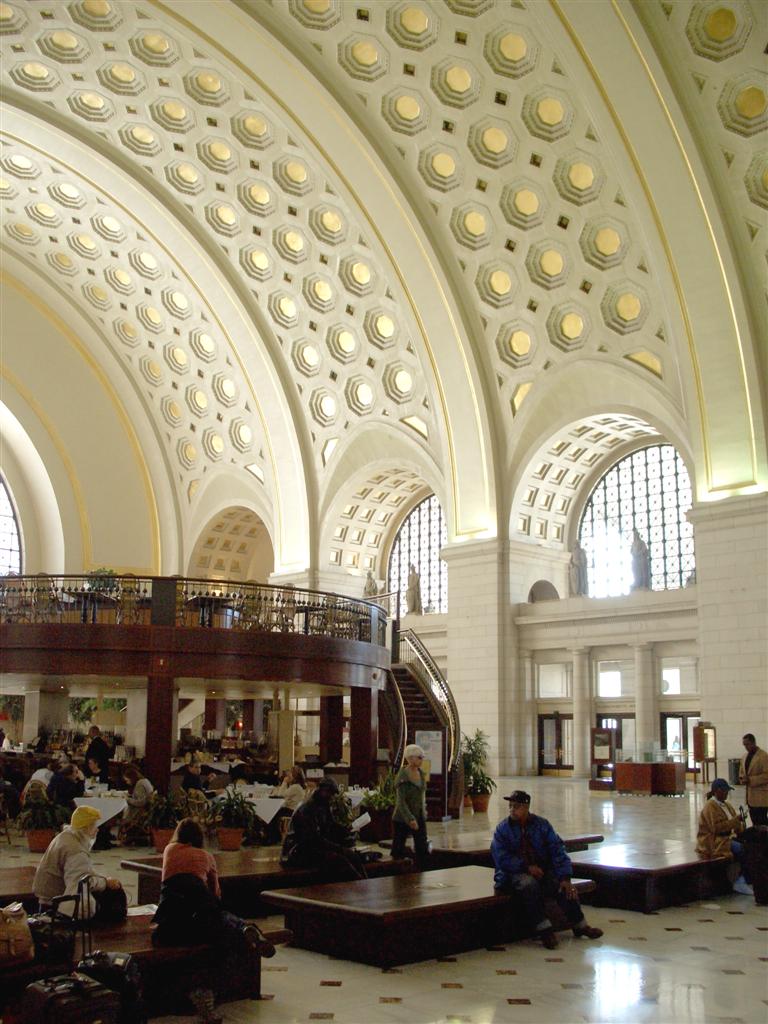
I'm really fond of 30th St Station because of its Art Deco theme, but I can't resist a good neoclassical building! I especially appreciated the gold accents, which warmed up what could otherwise have been a rather chilly space.
The station is home to a veritable shopping mall of upscale stores, including at least two chocolate shops and an old-fashioned barber. I went to the bookstore to see if I could get a copy of the NYTimes, since I could only get a Washington Post from Sean's 7-11, and I discovered to my disgust that a copy of the Sunday edition costs $6.00. That's way, way too much, especially as this particular edition didn't look that much more plump than the Post, which cost me a whopping $2.50. Luckily, I had brought a book with me in addition to the paper, so I wasn't totally unemployed for the remaining hours of the trip.
I was very glad to be wearing Phyllis' lovely lined boots once I got off at my stop, because there were gigantic puddles and 10 ft-high snowbanks at every corner. Our street was horribly plowed, leaving a 3 inch-high hard surface of packed snow in the center of the road, which a Mercedes was spinning its wheels in in front of my house as I walked up. He was gone by the time I had picked my way back from the grocery store, which at one point involved scaling an avalanche caused by one of the monster snow pile falling into the sidewalk. I dug out around my car last week to prevent rust, but there's no way I could actually get it out right now, and given that my two back tires are apparently in desperate need of replacement, I'm in no hurry to try to drive in the snow. There's more snow in the forecast for tomorrow, too. Whoopee.
However, despite all the travails of traveling, it was certainly worth it to spend a few days with Sean in Virginia. Even for a few days, it's nice to pretend that we're a normal married couple, going to the grocery store, going out to dinner, playing Scrabble (I'll freely admit that I'm the sorest Scrabble-loser ever, but it always makes Sean crack up, and that makes me laugh). In short, I have the best husband ever, and I love him so much.
It was a fairly uneventful ride, made slightly less pleasant by my discovery, as soon as we pulled out of Charlottesville (leaving Sean behind, which is always very depressing), that my mp3 player had gone on the fritz and needed its software reinstalled. That meant no music for the duration, which was fine until we reached Washington and the train was flooded with a bunch of high school students returning from a trip to the capital. Even with my earplugs in I could hear them, most of them talking louder than necessary so as to be heard on their cell phones. Plus, the kid who sat next to me did that thing where he fell asleep and kept listing dangerously toward my shoulder. I've never actually had that happen before, and I was kind of plastering myself against the window and contemplating poking him, but luckily he tipped too far and woke himself up.
I got out at Washington since the train made a 30-min stopover. It felt very old-timey, like back in the days when you could be riding a train cross country for days or weeks at a time, and everyone piled outside at all the stops to get some fresh air. I'm thinking Dr. Quinn-era here, pretty much (but alas, no Sully was forthcoming). Anyway, I also wanted to see what Union Station looked like, and it is quite beautiful:
I'm really fond of 30th St Station because of its Art Deco theme, but I can't resist a good neoclassical building! I especially appreciated the gold accents, which warmed up what could otherwise have been a rather chilly space.
The station is home to a veritable shopping mall of upscale stores, including at least two chocolate shops and an old-fashioned barber. I went to the bookstore to see if I could get a copy of the NYTimes, since I could only get a Washington Post from Sean's 7-11, and I discovered to my disgust that a copy of the Sunday edition costs $6.00. That's way, way too much, especially as this particular edition didn't look that much more plump than the Post, which cost me a whopping $2.50. Luckily, I had brought a book with me in addition to the paper, so I wasn't totally unemployed for the remaining hours of the trip.
I was very glad to be wearing Phyllis' lovely lined boots once I got off at my stop, because there were gigantic puddles and 10 ft-high snowbanks at every corner. Our street was horribly plowed, leaving a 3 inch-high hard surface of packed snow in the center of the road, which a Mercedes was spinning its wheels in in front of my house as I walked up. He was gone by the time I had picked my way back from the grocery store, which at one point involved scaling an avalanche caused by one of the monster snow pile falling into the sidewalk. I dug out around my car last week to prevent rust, but there's no way I could actually get it out right now, and given that my two back tires are apparently in desperate need of replacement, I'm in no hurry to try to drive in the snow. There's more snow in the forecast for tomorrow, too. Whoopee.
However, despite all the travails of traveling, it was certainly worth it to spend a few days with Sean in Virginia. Even for a few days, it's nice to pretend that we're a normal married couple, going to the grocery store, going out to dinner, playing Scrabble (I'll freely admit that I'm the sorest Scrabble-loser ever, but it always makes Sean crack up, and that makes me laugh). In short, I have the best husband ever, and I love him so much.
Saturday, February 13, 2010
Our First Married Valentine
Technically Valentine's day is tomorrow, but since I have to be on a train at 11am, we decided to celebrate today! We exchanged our little tokens this morning and will be going out to dinner tonight. In the interim, Sean has to go to work, so I'm headed to the Fine Arts library to do some research. Let's focus a second on the fact that this school not only HAS a Fine Arts library, but that library has almost every one of the books that I have been patiently awaiting via interlibrary loan. Sigh.
Unfortunately, the nature of my hasty flight southward means that I have no dressy clothes to wear out tonight. Originally I was supposed to leave Wednesday, with a suitcase. Then two feet of snow fell and I switched my train to Thursday and packed an shoulder overnight bag. Then I woke up Thursday and found out that almost all the trains, including my R7, weren't running, but that if I could make it about a mile in the knee- and sometimes thigh-deep snowdrifts I could catch the R8, which was somehow still working. So I put whatever I could fit into my backpack and braved the elements all the way to Allen Lane Station. The things one does for love!
Unfortunately, the nature of my hasty flight southward means that I have no dressy clothes to wear out tonight. Originally I was supposed to leave Wednesday, with a suitcase. Then two feet of snow fell and I switched my train to Thursday and packed an shoulder overnight bag. Then I woke up Thursday and found out that almost all the trains, including my R7, weren't running, but that if I could make it about a mile in the knee- and sometimes thigh-deep snowdrifts I could catch the R8, which was somehow still working. So I put whatever I could fit into my backpack and braved the elements all the way to Allen Lane Station. The things one does for love!
Tuesday, February 09, 2010
Students and a Snow Day
I had to be on campus today, which is one of my off days, to administer a make-up exam for a student who contracted mono at the end of last semester. He wasn't a particularly bright student; in fact, he was one-half of what I called Tweedledum and Tweedledee, two guys who sat in the far back corner of class and laughed to each other the whole time (the other half of T & T, incidentally, was responsible for some of the "crap emails from a student" that I posted here a few months ago. Not a stellar pair, let me tell you).
When he came in, he handed me his mess of a final paper, which ostensibly compared Thomas Cole's Oxbow to Monet's Japanese Garden with Footbridge, but which had no thesis, virtually no intelligent content, grievous spelling and grammar mistakes, and which wasted a large paragraph (in the 2-page paper) describing the "fact" that Monet dug the pond, built the footbridge, and planted all the flowers himself, while Cole just went out into nature and painted what he saw, like a loser. *facepalm*
I gave him a C- on the paper, mainly out of pity and because hey, he had serious mono for three months; that sucks. In freshman year, a certain portly, egotistical art history professor basically gave me a free pass on the exam that I got a C+ on because I had the (extremely mild) mono at the time (he also wrote "You are the Lion Queen!" on the top of a visual analysis I handed in about the lions from the Processional Way of the Ishtar Gate, but he totally forgot my name the next semester).
But I digress. The abysmal paper would have been bad enough, if not for the exam itself, on which he scored a whopping 36. Among his many faux-pas? He identified the Vietnam Veterans Memorial as Jean-Claude and Christo's Running Fence. Let's think about that. He saw a slide of this:

and said it was this:

This is not a case of seeing a Monet and mistaking it for a Matisse. He even described the medium as "nylon fabric, poles, and steel cable." *facepalm redux*
However, there is a positive on the school front, and that is: SNOW DAY TOMORROW!!
When he came in, he handed me his mess of a final paper, which ostensibly compared Thomas Cole's Oxbow to Monet's Japanese Garden with Footbridge, but which had no thesis, virtually no intelligent content, grievous spelling and grammar mistakes, and which wasted a large paragraph (in the 2-page paper) describing the "fact" that Monet dug the pond, built the footbridge, and planted all the flowers himself, while Cole just went out into nature and painted what he saw, like a loser. *facepalm*
I gave him a C- on the paper, mainly out of pity and because hey, he had serious mono for three months; that sucks. In freshman year, a certain portly, egotistical art history professor basically gave me a free pass on the exam that I got a C+ on because I had the (extremely mild) mono at the time (he also wrote "You are the Lion Queen!" on the top of a visual analysis I handed in about the lions from the Processional Way of the Ishtar Gate, but he totally forgot my name the next semester).
But I digress. The abysmal paper would have been bad enough, if not for the exam itself, on which he scored a whopping 36. Among his many faux-pas? He identified the Vietnam Veterans Memorial as Jean-Claude and Christo's Running Fence. Let's think about that. He saw a slide of this:
and said it was this:
This is not a case of seeing a Monet and mistaking it for a Matisse. He even described the medium as "nylon fabric, poles, and steel cable." *facepalm redux*
However, there is a positive on the school front, and that is: SNOW DAY TOMORROW!!
Saturday, February 06, 2010
Snowed In
That is a literal title, as our snow count hit 26 inches! Phyllis went out and measured it (and did all the shoveling without asking me to assist, which I felt guilty about when I realized it, but also happy because, you know, no freezing my ass off). This is a record snowstorm for Philadelphia, and it pretty much shut everything down.
We rescheduled our field trip to the Penn museum for tomorrow, although two of the TAs begged off because they had plans. Yes, OK, I didn't have plans besides doing schoolwork, but that doesn't mean I want to squire their students around the museum in addition to my own. Amy, our head TA, pointed out that I'll be even with them for covering my classes next Friday, but I call bullshit on that, because next Friday the art librarian is taking over the entire class to teach them about research and things. So all they need to do is take attendance! Sigh. On the plus side, while they're listening to that boring stuff, I'll be in Virginia with Sean!
I can also do what my friend Lisa calls "the happy thesis dance," because I finished my first chapter today! It's only 9 pages, true, but when you have four chapters and a 40-page goal, they're all going to end up being about that size. Yes: this means I'm a quarter of the way done, and more so, really, since a lot of chapter three (about the frescos themselves) I'm going to draw from the paper I wrote last semester, and chapter four is going to be pretty short and easy. Basically, chapter two (which will be all about the structure of the villa itself and where it's derived from) is going to be the most difficult and require the most research. I'm probably going to write that after I get back from Bergamo in March, hopefully armed with lots of helpful information from the library there and with pictures of the villa's exterior.
I've pretty much resigned myself to that fact that I will not be getting in to see the frescos. I've emailed (and faxed) everyone I can think of, and I haven't gotten a single response, which is kind of discouraging. It's entirely possible that they see an inquiry coming from an American grad student and just don't care, however meticulously polished my Italian is (and I made sure to have Carla read over every damn email, so I know it was!). Still, the courteous thing to do would have been a one-line email saying they couldn't help me. On the plus side, that means we won't have to spend $200 renting an automatic-transmission car. That's 146 euros more for other stuff.
Oh yes: less than a month until we're off! Whee!!
We rescheduled our field trip to the Penn museum for tomorrow, although two of the TAs begged off because they had plans. Yes, OK, I didn't have plans besides doing schoolwork, but that doesn't mean I want to squire their students around the museum in addition to my own. Amy, our head TA, pointed out that I'll be even with them for covering my classes next Friday, but I call bullshit on that, because next Friday the art librarian is taking over the entire class to teach them about research and things. So all they need to do is take attendance! Sigh. On the plus side, while they're listening to that boring stuff, I'll be in Virginia with Sean!
I can also do what my friend Lisa calls "the happy thesis dance," because I finished my first chapter today! It's only 9 pages, true, but when you have four chapters and a 40-page goal, they're all going to end up being about that size. Yes: this means I'm a quarter of the way done, and more so, really, since a lot of chapter three (about the frescos themselves) I'm going to draw from the paper I wrote last semester, and chapter four is going to be pretty short and easy. Basically, chapter two (which will be all about the structure of the villa itself and where it's derived from) is going to be the most difficult and require the most research. I'm probably going to write that after I get back from Bergamo in March, hopefully armed with lots of helpful information from the library there and with pictures of the villa's exterior.
I've pretty much resigned myself to that fact that I will not be getting in to see the frescos. I've emailed (and faxed) everyone I can think of, and I haven't gotten a single response, which is kind of discouraging. It's entirely possible that they see an inquiry coming from an American grad student and just don't care, however meticulously polished my Italian is (and I made sure to have Carla read over every damn email, so I know it was!). Still, the courteous thing to do would have been a one-line email saying they couldn't help me. On the plus side, that means we won't have to spend $200 renting an automatic-transmission car. That's 146 euros more for other stuff.
Oh yes: less than a month until we're off! Whee!!
Wednesday, February 03, 2010
Suffer the Little Children
So, despite the fact that one of my students approached me today after class to ask where he might find a map that would show him the locations of such exotic spots as Rome and Athens, I'm liking the whole teaching thing right now. Why? I got my evaluation forms back from last semester, and I rock!
Some choice statements:
"Michelle is cool"
"The way she taught was excellent"
"Best TA I've had at Temple"
"Strong presence, good voice"
and my personal favorite, in response to "how would you change the class?": "Nothing, she was a fox."
Out of the mouths of babes...
Some choice statements:
"Michelle is cool"
"The way she taught was excellent"
"Best TA I've had at Temple"
"Strong presence, good voice"
and my personal favorite, in response to "how would you change the class?": "Nothing, she was a fox."
Out of the mouths of babes...
Saturday, January 30, 2010
Snow Day's Eve

Ah, the Saturday evening of a snowed-in grad student with the house to herself: watching Pride & Prejudice (the Firth version) and making slow progress on saving all of my Rome photos. Four hundred down, seven hundred to go!
The picture above is the church of St. John Lateran, which is the second-largest church in Rome, second only to St. Peter's. It is the official episcopal seat of the pope (rather than St. Peter's, as one might assume). Together with the Vatican, Santa Maria Maggiore and St. Paul Outside the Walls, the Lateran is one of the city's four papal basilicas: huge churches that feature a "holy door," a central portal that is only open during Jubilee years.
I went to the Lateran before going to St. Peter's, and I think the sheer vastness of its scale resulted in being less impressed by the Vatican than I had been the first time I saw it. It's also much more light-filled than the Vatican, which always seems to be filled with a low, golden light that makes for a lot of shadows in the side-aisles. The Lateran had a beautiful cloister to boot:

Tuesday, January 26, 2010
Degli Errori de' Pittori
On the Errors of the Painters is a treatise published in 1546 by Giovanni Gilio. Dedicated to the Italian Cardinal Farnese, it takes the form of a dialogue between six learned men of Rome, who spend a day lounging on the bank of a river arguing about all the way in which ignorant modern artists have royally mucked up the most noble art of painting.
Gilio actually finished the work in 1542, but he waited four years to publish it. He was waiting, in fact, for Michelangelo, the 89-year-old Il Divino, to die. Why? In central Italy there was no artist that could compete with Michelangelo's reputation (and in the rest of Italy, and indeed Europe at this time, only Titian exceeded him), and to the end of his life he was held in the highest esteem in many powerful circles in Rome. So, if you're going to write a treatise that effectively blames Michelangelo for everything that's wrong with modern painting, it's a politic move to delay publication till he's out of the picture, right?
By the time Gilio was writing, the humanistic attitude of the Renaissance was on its way out, to be replaced by the zealousness of the Counter-Reformation. The Church found itself under attack at mid-century, and could no longer afford to tolerate the kind of art that had proliferated during the previous 50 years. That was a highly intellectual art, one which frequently employed quotations of other works of art, both contemporary and ancient, and used lots of literary allusions and pagan themes. It was art for the elite, and the Counter-Reformation decided that that was no longer appropriate. Art became a powerful tool of propaganda. By the end of the Council of Trent in 1563, an edict would require certain standards of religious art: it had to be clear enough so that the popolo could understand; it should draw them in by appealing to their emotions; and it should be decorous and accurate. Lack of decorum and accuracy were probably the two biggest complaints Gilio had against contemporary artists, chief among them Michelangelo.
Poor Michelangelo! He was probably the most devout Renaissance artist of all of them, and yet to hear Gilio tell it, everything he did he did out of vanity, ignorance, and pride. Gilio found fault chiefly with Michelangelo's style, particularly in the Last Judgment. The massive fresco in the Sistine Chapel had been commissioned in the 1530s, the final hurrah for the Renaissance, but was unveiled in 1541, when the stirrings of the Counter-Reformation had already begun.

The artist covered the altar wall of the pope's personal chapel with four hundred monumental nude figures, each one demonstrating a superhuman musculature, and each one twisting and writhing in a completely unique pose. Four hundred figures, and not one repetition of pose or gesture. That's incredible by any standard, and Gilio applauds him for it. The problem for Gilio and many others, is that the viewer looks at this fresco and admires the hand of Michelangelo, instead of cowering in fear at the terrible event that is the Last Judgment. There's too much art in it, basically; Michelangelo is showing off, and that robs it of its power to teach--and more importantly, of its power to inspire fear.
Gilio comes up with many abuses in his treatise, each of which is helpfully illustrated by some work done by Michelangelo. For example, he argues that painters should be extremely well-versed in the biblical stories they depict, and then paint them as accurately as possible. People in the Roman era should not wear contemporary attire; women should not have ridiculously masculine bodies; Christ should not be crucified on a cross of gold adorned with jewels. In the Last Judgment, there are two groups of angels in the lunettes, flying and tumbling and lugging the cross and column through the sky.

He derisively identifies them as mummers or jugglers, and questions why, if a single angel can hold up the globe, or turn a celestial sphere, can't a dozen of them carry one column? If a wounded Christ and Simon of Cyrene could carry that cross, how come a bunch of angels seem to be struggling? He also takes issue with the habit of painting draperies and hair as though they're being blown by strong winds, often with the effect of revealing basically everything of the body beneath (which is an artistic tradition going as far back as Classical Greece). Of such figures in the LJ, he notes, rather snarkily, that there will not be any wind on the day of Judgment. 16th-century sarcasm! I love it!
These are just a few of his complaints, and I'm only halfway through a 115-page treatise. Among the others are his disapproval of the way that people are contorted into unnatural poses, and that Christ is just not scary-looking enough to be the Judge. I haven't gotten to his thoughts on the nudity yet, but I'm sure that will be entertaining. That was what shocked people most about the LJ--everyone, with the exceptions of Jesus and Mary, was completely nude. It was entirely correct from a theological standpoint: on the day of judgment, all signs of earthly identity will be cast away, and everyone will be made equal. The same goes for the overly-muscular bodies, which are Michelangelo's representation of the perfected, heavenly bodies Paul promised everyone would receive. Practically speaking, though, a lot of people found it inappropriate to have genitalia flapping in the breeze above the pope's altar. Just like with Gilio's publication, though, nothing was done while the old master was alive, but immediately after his death, one of his pupils, Daniele da Volterra, was called into and assigned the task of giving everyone a bit of drapery in the right place, a job that earned him the nickname of "the britches-maker" in Rome. He never finished the job, so there are still many unclothed individuals.
Incidentally, in class yesterday Dr. Hall gave us some insider's info on the decision that was made at the time of the LJ's cleaning in the 1990s not to remove Daniele's work. She and a bunch of other scholars were at the Vatican participating in a symposium on the fresco, when they were invited to a private papal audience. During the audience, JPII told them that the Vatican would have no objection to removing the over-painting. Everyone rejoiced! However, the Vatican curators ultimately chose not to do it, which Dr. Hall said she has always felt was a mistake; she finds them unsightly, especially as they are noticeably darker than the original fresco (due to the wall having darkened with smoke in the 20 years between the completion and Daniele's work). The conservators took a typically Italian stance and said that the additions are part of the fresco's history, a position I personally agree with.
This has been a really long blog post for me, but I do find this subject quite interesting. Also, this treatise was my 'assignment' for Dr. Hall's class next week, so I'll be doing a brief presentation on Gilio and his objections. I'm not reading 115 pages of 16th-century Italian treatise for fun, I assure you. This is what comes of raising your hand in class when the professor asks "remind me, who reads Italian?"
Finally, here's everyone's favorite figure, the Anguished Reprobate:

Gilio actually finished the work in 1542, but he waited four years to publish it. He was waiting, in fact, for Michelangelo, the 89-year-old Il Divino, to die. Why? In central Italy there was no artist that could compete with Michelangelo's reputation (and in the rest of Italy, and indeed Europe at this time, only Titian exceeded him), and to the end of his life he was held in the highest esteem in many powerful circles in Rome. So, if you're going to write a treatise that effectively blames Michelangelo for everything that's wrong with modern painting, it's a politic move to delay publication till he's out of the picture, right?
By the time Gilio was writing, the humanistic attitude of the Renaissance was on its way out, to be replaced by the zealousness of the Counter-Reformation. The Church found itself under attack at mid-century, and could no longer afford to tolerate the kind of art that had proliferated during the previous 50 years. That was a highly intellectual art, one which frequently employed quotations of other works of art, both contemporary and ancient, and used lots of literary allusions and pagan themes. It was art for the elite, and the Counter-Reformation decided that that was no longer appropriate. Art became a powerful tool of propaganda. By the end of the Council of Trent in 1563, an edict would require certain standards of religious art: it had to be clear enough so that the popolo could understand; it should draw them in by appealing to their emotions; and it should be decorous and accurate. Lack of decorum and accuracy were probably the two biggest complaints Gilio had against contemporary artists, chief among them Michelangelo.
Poor Michelangelo! He was probably the most devout Renaissance artist of all of them, and yet to hear Gilio tell it, everything he did he did out of vanity, ignorance, and pride. Gilio found fault chiefly with Michelangelo's style, particularly in the Last Judgment. The massive fresco in the Sistine Chapel had been commissioned in the 1530s, the final hurrah for the Renaissance, but was unveiled in 1541, when the stirrings of the Counter-Reformation had already begun.

The artist covered the altar wall of the pope's personal chapel with four hundred monumental nude figures, each one demonstrating a superhuman musculature, and each one twisting and writhing in a completely unique pose. Four hundred figures, and not one repetition of pose or gesture. That's incredible by any standard, and Gilio applauds him for it. The problem for Gilio and many others, is that the viewer looks at this fresco and admires the hand of Michelangelo, instead of cowering in fear at the terrible event that is the Last Judgment. There's too much art in it, basically; Michelangelo is showing off, and that robs it of its power to teach--and more importantly, of its power to inspire fear.
Gilio comes up with many abuses in his treatise, each of which is helpfully illustrated by some work done by Michelangelo. For example, he argues that painters should be extremely well-versed in the biblical stories they depict, and then paint them as accurately as possible. People in the Roman era should not wear contemporary attire; women should not have ridiculously masculine bodies; Christ should not be crucified on a cross of gold adorned with jewels. In the Last Judgment, there are two groups of angels in the lunettes, flying and tumbling and lugging the cross and column through the sky.

He derisively identifies them as mummers or jugglers, and questions why, if a single angel can hold up the globe, or turn a celestial sphere, can't a dozen of them carry one column? If a wounded Christ and Simon of Cyrene could carry that cross, how come a bunch of angels seem to be struggling? He also takes issue with the habit of painting draperies and hair as though they're being blown by strong winds, often with the effect of revealing basically everything of the body beneath (which is an artistic tradition going as far back as Classical Greece). Of such figures in the LJ, he notes, rather snarkily, that there will not be any wind on the day of Judgment. 16th-century sarcasm! I love it!
These are just a few of his complaints, and I'm only halfway through a 115-page treatise. Among the others are his disapproval of the way that people are contorted into unnatural poses, and that Christ is just not scary-looking enough to be the Judge. I haven't gotten to his thoughts on the nudity yet, but I'm sure that will be entertaining. That was what shocked people most about the LJ--everyone, with the exceptions of Jesus and Mary, was completely nude. It was entirely correct from a theological standpoint: on the day of judgment, all signs of earthly identity will be cast away, and everyone will be made equal. The same goes for the overly-muscular bodies, which are Michelangelo's representation of the perfected, heavenly bodies Paul promised everyone would receive. Practically speaking, though, a lot of people found it inappropriate to have genitalia flapping in the breeze above the pope's altar. Just like with Gilio's publication, though, nothing was done while the old master was alive, but immediately after his death, one of his pupils, Daniele da Volterra, was called into and assigned the task of giving everyone a bit of drapery in the right place, a job that earned him the nickname of "the britches-maker" in Rome. He never finished the job, so there are still many unclothed individuals.
Incidentally, in class yesterday Dr. Hall gave us some insider's info on the decision that was made at the time of the LJ's cleaning in the 1990s not to remove Daniele's work. She and a bunch of other scholars were at the Vatican participating in a symposium on the fresco, when they were invited to a private papal audience. During the audience, JPII told them that the Vatican would have no objection to removing the over-painting. Everyone rejoiced! However, the Vatican curators ultimately chose not to do it, which Dr. Hall said she has always felt was a mistake; she finds them unsightly, especially as they are noticeably darker than the original fresco (due to the wall having darkened with smoke in the 20 years between the completion and Daniele's work). The conservators took a typically Italian stance and said that the additions are part of the fresco's history, a position I personally agree with.
This has been a really long blog post for me, but I do find this subject quite interesting. Also, this treatise was my 'assignment' for Dr. Hall's class next week, so I'll be doing a brief presentation on Gilio and his objections. I'm not reading 115 pages of 16th-century Italian treatise for fun, I assure you. This is what comes of raising your hand in class when the professor asks "remind me, who reads Italian?"
Finally, here's everyone's favorite figure, the Anguished Reprobate:

Sunday, January 24, 2010
Venice in Three Days: The Itinerary
Actually, there's no set itinerary just yet, but I did make a list of all the places I want to get to while we're there. Beyond the ones I mentioned earlier (San Marco, the Accademia, and Museo Correr) it's basically all churches: the Gesuati, S. Sebastiano, Madonna del Orto, the Frati, the Salute, SS. Giacomo e Paolo, Madonna dei Miracoli, the Redentore, and S. Giorgio Maggiore. Maybe the Ducal Palace, too, for those marvelous Tintorettos, but we might not have time, and I've seen them before. Alright, I've been in most of these churches before too, but it's so much easier to nip into a church than to get through the palace!
Tops on my list are Palladio's two churches in Venice, both of which are not on the main island but across the bacino. San Giorgio Maggiore is on its own little island, which is just called San Giorgio. Begun in 1566 as part of the island's monastic complex, it represents Palladio's first use of a classical temple front on a church (he achieved his greatest fame for his suburban villas on the mainland, in which for the first time he used temple facades on secular homes).

In order to compensate for the high nave and lower side aisles of a typical Christian basilica-style church, he superimposed one tall, vertical temple front over a lower, wider one. The ultimate effect is not, in my opinion, his most attractive work, especially considering how he refined this program later at the Redentore. However, it demonstrates Palladio's interest in classical language and his preference for pure white facades (which work dazzlingly well with the water of the lagoon). The belltower apparently affords amazing views of San Marco.
The church of the Redentore (Redeemer) has a different background and evolution. It was a votive church, commissioned directly by the state in response to a devastating plague that swept through Venice in 1576-7, killing around 46,000 people. Following tradition, the Venetian Senate publicly declared that they would make a solemn procession to the church every year if the city would be spared. Palladio won the commission. There's evidence that he originally wanted to build a centrally-planned church with a circular groundplan, an idea that was hotly debated and eventually shot down (central-plans were often considered too pagan for Christian churches, though there were some built during the Renaissance, mostly in chapel form). However, Palladio cleverly designed the church so that when seen, as it would always have been, from the piazzetta on the main island, it looks like this:

The compact silhouette of the superimposed facades, combined with the high Byzantine-style dome, suggests a centrally-planned domed building rather than a basilica plan. In fact, the interior looks like this:
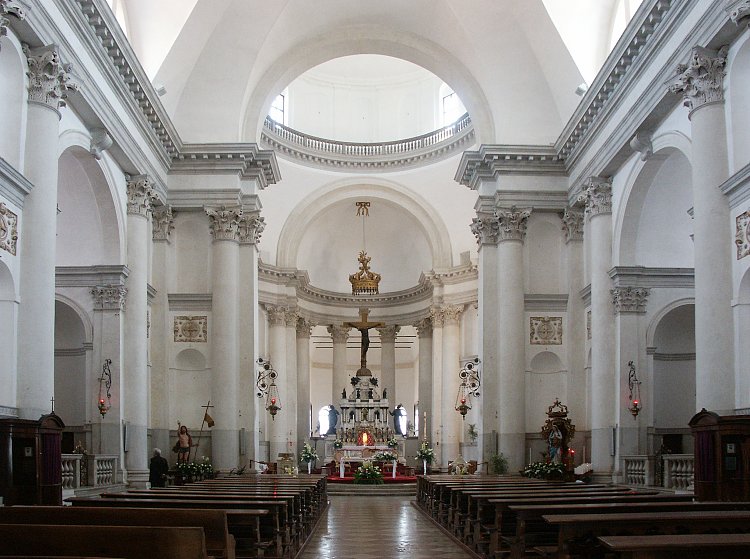
Palladio believed very strongly in limiting the interior decoration of churches, preferring a white and gray palette, which only increases the sense of lofty space. That makes him somewhat of an oddity in the annals of architectural history, for this was already the era of the great Roman Baroque churches with their splendid, overwhelming decoration. Palladio's grand manner was well-suited to Venice, however, considering the independence from Rome that the Republic always insisted upon.
For centuries after the church's completion, the Festa del Redentore was one of the city's most solemn ceremonial occasions. The entire populace, led by the doge, crossed the bacino on a floating pontoon bridge to offer thanks. The votive procession continues to this day, every third Sunday in July, though the participants are largely tourists, thanks to Venice's ever-declining native population.

While I would love to participate in this someday, I'm not sure you could pay me to be in Venice in July. It's a tight squeeze into those narrow streets and alleys even in the off-season. I'll still enjoy visiting Palladio's two great churches, though, even if I can't walk on water to get there.
Tops on my list are Palladio's two churches in Venice, both of which are not on the main island but across the bacino. San Giorgio Maggiore is on its own little island, which is just called San Giorgio. Begun in 1566 as part of the island's monastic complex, it represents Palladio's first use of a classical temple front on a church (he achieved his greatest fame for his suburban villas on the mainland, in which for the first time he used temple facades on secular homes).
In order to compensate for the high nave and lower side aisles of a typical Christian basilica-style church, he superimposed one tall, vertical temple front over a lower, wider one. The ultimate effect is not, in my opinion, his most attractive work, especially considering how he refined this program later at the Redentore. However, it demonstrates Palladio's interest in classical language and his preference for pure white facades (which work dazzlingly well with the water of the lagoon). The belltower apparently affords amazing views of San Marco.
The church of the Redentore (Redeemer) has a different background and evolution. It was a votive church, commissioned directly by the state in response to a devastating plague that swept through Venice in 1576-7, killing around 46,000 people. Following tradition, the Venetian Senate publicly declared that they would make a solemn procession to the church every year if the city would be spared. Palladio won the commission. There's evidence that he originally wanted to build a centrally-planned church with a circular groundplan, an idea that was hotly debated and eventually shot down (central-plans were often considered too pagan for Christian churches, though there were some built during the Renaissance, mostly in chapel form). However, Palladio cleverly designed the church so that when seen, as it would always have been, from the piazzetta on the main island, it looks like this:
The compact silhouette of the superimposed facades, combined with the high Byzantine-style dome, suggests a centrally-planned domed building rather than a basilica plan. In fact, the interior looks like this:
Palladio believed very strongly in limiting the interior decoration of churches, preferring a white and gray palette, which only increases the sense of lofty space. That makes him somewhat of an oddity in the annals of architectural history, for this was already the era of the great Roman Baroque churches with their splendid, overwhelming decoration. Palladio's grand manner was well-suited to Venice, however, considering the independence from Rome that the Republic always insisted upon.
For centuries after the church's completion, the Festa del Redentore was one of the city's most solemn ceremonial occasions. The entire populace, led by the doge, crossed the bacino on a floating pontoon bridge to offer thanks. The votive procession continues to this day, every third Sunday in July, though the participants are largely tourists, thanks to Venice's ever-declining native population.
While I would love to participate in this someday, I'm not sure you could pay me to be in Venice in July. It's a tight squeeze into those narrow streets and alleys even in the off-season. I'll still enjoy visiting Palladio's two great churches, though, even if I can't walk on water to get there.
Friday, January 22, 2010
Scaring Small Children
Well, no, they're not small children, they're college students, but scare them I did! I just had my first section, and you should have seen the faces fall when I told them that AWW is not an easy-A class. It moves really quickly, especially for people with zero historical/geographical understanding, it requires memorization, and there's quite a bit of reading, plus field trips and a paper. It's definitely not a picnic. However, I laid all of that out up front today when I read through the entire syllabus with them, so if they stay in the class they can't claim that we sprung anything on them.
One kid came up to me afterward and said "Um, I was kinda nervous about this class before, and now I'm really scared...when's the drop deadline?" Unfortunately, he wasn't from my 12 PM class, which has 35 students instead of what's supposed to be the limit of 28. That class, which I will convene in seven minutes, I will subtly encourage kids to DROP DROP DROP!
One kid came up to me afterward and said "Um, I was kinda nervous about this class before, and now I'm really scared...when's the drop deadline?" Unfortunately, he wasn't from my 12 PM class, which has 35 students instead of what's supposed to be the limit of 28. That class, which I will convene in seven minutes, I will subtly encourage kids to DROP DROP DROP!
Sunday, January 17, 2010
The Joys of Trip-Planning
Sometimes I think that had I not decided to pursue an academic path, I would have wanted to work in the travel industry. I love planning trips, making itineraries, and looking at hotel websites; to a slightly lesser extent, I also love the pre-departure hoopla, the checking of tickets and passports, the packing (and re-packing, if you're me) of suitcases, and the selection of that perfect plane-ride book. Ah.
Of course, all that pales in comparison to that actual trips themselves! Sean and I will be off on our latest adventure in less than two months. It's only going to be a week, since we'll both be on spring break. We leave that Friday from Philadelphia, and fly to Milan by way of Charles de Gaulle, where I decided on a comfortable four-hour layover, rather than chance the one and a half hour layover itinerary. We'll get in around 3 in the afternoon, take the train into the city, drop off our bags at the hotel (I decided to risk one of the ones by the train station), and wander around. From what I've heard, there's not much to see in Milan besides the Brera art gallery and the Duomo:

(According to what I learned in my Romanesque and Gothic class in Florence, the rather odd proportions of this building are due to a battle of wills between the French Gothic architects, who wanted to build it high and light-filled, and the Lombard craftsmen, who wanted to build it like they knew, heavy and low to the ground. Voila.)
We'll go to the Brera in the morning, and then head off to Bergamo, which is about an hour away by train. We're staying in an adorable B&B perched underneath the Venetian-era city walls, which is perfect for me: Paolo Cassotti's neighborhood is outside the walls, in the Citta Bassa or "lower city," and the museums and cathedral are up in the Citta Alta. The climb is apparently pretty steep, and though there is a furnicular Sean has already assured me that we won't be using it.
My itinerary for Bergamo is sort of unsettled. A lot depends on if I can get permission to go to Trescore Balneario, about 9 miles away, to see the frescoes I'm working on. If that goes through, we'll need to rent a car for a day, hopefully Monday when the museum's closed. I checked with Avis and a one-day rental of an automatic car, with underage surchage and a GPS device, will be around $150. Ugh. Damn manual transmissions! If the visit doesn't happen, that's OK. I have the museum and a plethora of churches to visit, as well as Cassotti's house in the city and the villa in the suburbs. There's a slight, slight chance I might be able to get in and see the building, but since it's being turned into condominiums I'm suspecting that that's a very slight chance indeed. Still, if I can get some photos of the structure that don't come from a 1970s conservation document I found online, that would be awesome. Finally, time permitting I'd also like to go to the city library to see what I can dig up just by some basic search--this is not the time for real archival research, since we're only in town for three days.
On Wednesday, we'll head to Venice, a couple of hours away by train. We're staying in Canareggio. That's the northwestern sestiere, or sixth, of the city, so that means getting to anything is going to mean quite a bit of walking, but that's OK. It's another awesome-looking bed-and-breakfast. Carla and I stayed in Canareggio last time too, but that was such a basic place that breakfast was a packaged chocolate-filled croissant and some coffee. Still, fond memories cracking open the mini-bottles of prosecco in the fridge there.
Anyway! I haven't developed a Venetian itinerary yet, but the major hotspots will of course include San Marco, the Academia, and the Museo Correr. Jasmine has promised me a list of good eateries, and I definitely plan to go visit the sandwich shop she took us to near SS. Giacomo e Paolo and get one of those porchetta sandwiches. Delicious. We ate lunch that day on the steps of canal here, and the shop was just over the bridge at the left:

(Thanks to Canaletto, an 18th-century artist, for providing the excellent illustration) Dr. Cooper also suggested I meet up with a friend of hers, Richard Schofield, who teaches at UAV in Venice. I sent him an email, after the usual fraught debate about what wording sounded appropriately respectful but still interesting, but I haven't heard back yet.
Finally, that Saturday, we will take the vaporetto to the airport and be off. With any luck, we should be in Philadelphia again by 6pm. It's going to be quite the treat to be able to get off the plane, go to the parking lot, pick up my car, and just drive home. No waiting on a shuttle service or whoever's picking us up, and no two hours in the car from JFK (actually, coming back from Spain it was a disturbingly-short hour and a quarter or so, thanks to a lead-footed driver).
I'd like to travel light on this trip, as I try to everytime. I'm not sure if it's going to work. For Rome, I had my overnight bag and a carry-on sized luggage, but those were summer clothes, and I knew I could do laundry. This time it will be March, I might need a dressy outfit in case of meeting with official-type people or Italian counts, and I have have to fit in a slightly bulky European hairdryer, out of which I plan to wring every cent of its 40-euro, I-just-got-here-I'm-desperate-to-shower-and-this-is-the-closest-beauty-shop value. We might need to go the Greece route and have a single checked piece between us, which neither of us love to do, since there's the fear of lost luggage combined with the necessity of waiting around at the baggage claim (or, like in Madrid, breaking a security barrier to retrieve my luggage). It won't be too bad after that, though, as we're not moving around almost daily as we were in Spain--a good thing, too, since this time I can't just justify the expense of taxis by saying "It's our honeymoon!" Oh, youth.
Of course, all that pales in comparison to that actual trips themselves! Sean and I will be off on our latest adventure in less than two months. It's only going to be a week, since we'll both be on spring break. We leave that Friday from Philadelphia, and fly to Milan by way of Charles de Gaulle, where I decided on a comfortable four-hour layover, rather than chance the one and a half hour layover itinerary. We'll get in around 3 in the afternoon, take the train into the city, drop off our bags at the hotel (I decided to risk one of the ones by the train station), and wander around. From what I've heard, there's not much to see in Milan besides the Brera art gallery and the Duomo:
(According to what I learned in my Romanesque and Gothic class in Florence, the rather odd proportions of this building are due to a battle of wills between the French Gothic architects, who wanted to build it high and light-filled, and the Lombard craftsmen, who wanted to build it like they knew, heavy and low to the ground. Voila.)
We'll go to the Brera in the morning, and then head off to Bergamo, which is about an hour away by train. We're staying in an adorable B&B perched underneath the Venetian-era city walls, which is perfect for me: Paolo Cassotti's neighborhood is outside the walls, in the Citta Bassa or "lower city," and the museums and cathedral are up in the Citta Alta. The climb is apparently pretty steep, and though there is a furnicular Sean has already assured me that we won't be using it.
My itinerary for Bergamo is sort of unsettled. A lot depends on if I can get permission to go to Trescore Balneario, about 9 miles away, to see the frescoes I'm working on. If that goes through, we'll need to rent a car for a day, hopefully Monday when the museum's closed. I checked with Avis and a one-day rental of an automatic car, with underage surchage and a GPS device, will be around $150. Ugh. Damn manual transmissions! If the visit doesn't happen, that's OK. I have the museum and a plethora of churches to visit, as well as Cassotti's house in the city and the villa in the suburbs. There's a slight, slight chance I might be able to get in and see the building, but since it's being turned into condominiums I'm suspecting that that's a very slight chance indeed. Still, if I can get some photos of the structure that don't come from a 1970s conservation document I found online, that would be awesome. Finally, time permitting I'd also like to go to the city library to see what I can dig up just by some basic search--this is not the time for real archival research, since we're only in town for three days.
On Wednesday, we'll head to Venice, a couple of hours away by train. We're staying in Canareggio. That's the northwestern sestiere, or sixth, of the city, so that means getting to anything is going to mean quite a bit of walking, but that's OK. It's another awesome-looking bed-and-breakfast. Carla and I stayed in Canareggio last time too, but that was such a basic place that breakfast was a packaged chocolate-filled croissant and some coffee. Still, fond memories cracking open the mini-bottles of prosecco in the fridge there.
Anyway! I haven't developed a Venetian itinerary yet, but the major hotspots will of course include San Marco, the Academia, and the Museo Correr. Jasmine has promised me a list of good eateries, and I definitely plan to go visit the sandwich shop she took us to near SS. Giacomo e Paolo and get one of those porchetta sandwiches. Delicious. We ate lunch that day on the steps of canal here, and the shop was just over the bridge at the left:
(Thanks to Canaletto, an 18th-century artist, for providing the excellent illustration) Dr. Cooper also suggested I meet up with a friend of hers, Richard Schofield, who teaches at UAV in Venice. I sent him an email, after the usual fraught debate about what wording sounded appropriately respectful but still interesting, but I haven't heard back yet.
Finally, that Saturday, we will take the vaporetto to the airport and be off. With any luck, we should be in Philadelphia again by 6pm. It's going to be quite the treat to be able to get off the plane, go to the parking lot, pick up my car, and just drive home. No waiting on a shuttle service or whoever's picking us up, and no two hours in the car from JFK (actually, coming back from Spain it was a disturbingly-short hour and a quarter or so, thanks to a lead-footed driver).
I'd like to travel light on this trip, as I try to everytime. I'm not sure if it's going to work. For Rome, I had my overnight bag and a carry-on sized luggage, but those were summer clothes, and I knew I could do laundry. This time it will be March, I might need a dressy outfit in case of meeting with official-type people or Italian counts, and I have have to fit in a slightly bulky European hairdryer, out of which I plan to wring every cent of its 40-euro, I-just-got-here-I'm-desperate-to-shower-and-this-is-the-closest-beauty-shop value. We might need to go the Greece route and have a single checked piece between us, which neither of us love to do, since there's the fear of lost luggage combined with the necessity of waiting around at the baggage claim (or, like in Madrid, breaking a security barrier to retrieve my luggage). It won't be too bad after that, though, as we're not moving around almost daily as we were in Spain--a good thing, too, since this time I can't just justify the expense of taxis by saying "It's our honeymoon!" Oh, youth.
Saturday, January 16, 2010
The Great Girl Scout Cookie Quest, Or, In Search of Noms
Thursday was the kickoff for Girl Scout Cookie sales, and we already tried to locate some in our area with no success. However, it being a weekend, there should be someone outside the grocery store, so we're going to go there as soon as someone (cough Sean cough) manages to get dressed, and if we have no luck there, there's definitely a booth at the mall about half an hour from my house. Caramel Delights, here I come!
Thursday, January 14, 2010
My Big Beautiful Eyes
When I went to the eye doctor for an exam this summer, they told me--to my surprise--that I had a hole in one of my retinas. I'd been seeing flashing lights at the corner of one eye at night if I looked all the way in one direction, and they thought that's what had been causing it. When I went back for a re-exam in December, they said there were now multiple holes, in both eyes, and I would need them to be fixed via a laser procedure so that they wouldn't cause any problems in the future. OK, fine; I had an appointment with a retinal specialist from the same practice yesterday, so Sean and I got up and drove to this other office and wound up waiting about two hours post my appointment time for the doctor to actually get to me. It's the teaching institute of the PA School of Optometry, so it was kind of a madhouse, interns running too and fro. Finally, when the doctor got to me, he was very gruff and all business (though he did tell me he loved art history when he was an undergrad, and asked if the Jansen survey was still in use, which it is). He shone many, many bright lights in my eyes while poking my eye with a pen or something, which was very uncomfortable. Finally, he announced that he could not find the holes, because there were none. He said that because my eyes are so large and clear, and dilate so completely, the doctor who gave me the eye exam was actually able to see further in than they should have been able to, and thus misrecognized some benign thing at the waaaay back of my eye as a hole. In other words, I wasted two hours and $15 on holes that didn't exist. Blargh. I kind want to go to the other office and complain, but I'm also lazy, so that's unlikely.
Thursday, January 07, 2010
Five Years

This is the line from Jane Eyre that I wish that I had remembered to use after the wedding: "Reader, I married him."
I'm a lucky woman, can you tell?