Tops on my list are Palladio's two churches in Venice, both of which are not on the main island but across the bacino. San Giorgio Maggiore is on its own little island, which is just called San Giorgio. Begun in 1566 as part of the island's monastic complex, it represents Palladio's first use of a classical temple front on a church (he achieved his greatest fame for his suburban villas on the mainland, in which for the first time he used temple facades on secular homes).

In order to compensate for the high nave and lower side aisles of a typical Christian basilica-style church, he superimposed one tall, vertical temple front over a lower, wider one. The ultimate effect is not, in my opinion, his most attractive work, especially considering how he refined this program later at the Redentore. However, it demonstrates Palladio's interest in classical language and his preference for pure white facades (which work dazzlingly well with the water of the lagoon). The belltower apparently affords amazing views of San Marco.
The church of the Redentore (Redeemer) has a different background and evolution. It was a votive church, commissioned directly by the state in response to a devastating plague that swept through Venice in 1576-7, killing around 46,000 people. Following tradition, the Venetian Senate publicly declared that they would make a solemn procession to the church every year if the city would be spared. Palladio won the commission. There's evidence that he originally wanted to build a centrally-planned church with a circular groundplan, an idea that was hotly debated and eventually shot down (central-plans were often considered too pagan for Christian churches, though there were some built during the Renaissance, mostly in chapel form). However, Palladio cleverly designed the church so that when seen, as it would always have been, from the piazzetta on the main island, it looks like this:

The compact silhouette of the superimposed facades, combined with the high Byzantine-style dome, suggests a centrally-planned domed building rather than a basilica plan. In fact, the interior looks like this:
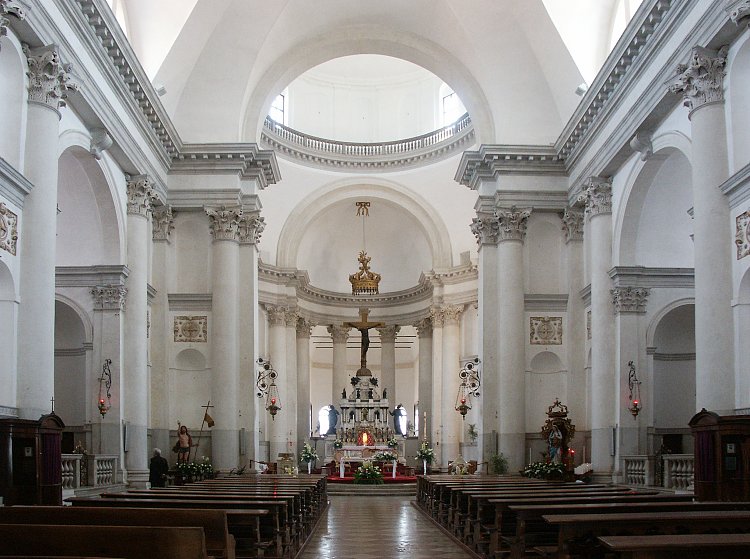
Palladio believed very strongly in limiting the interior decoration of churches, preferring a white and gray palette, which only increases the sense of lofty space. That makes him somewhat of an oddity in the annals of architectural history, for this was already the era of the great Roman Baroque churches with their splendid, overwhelming decoration. Palladio's grand manner was well-suited to Venice, however, considering the independence from Rome that the Republic always insisted upon.
For centuries after the church's completion, the Festa del Redentore was one of the city's most solemn ceremonial occasions. The entire populace, led by the doge, crossed the bacino on a floating pontoon bridge to offer thanks. The votive procession continues to this day, every third Sunday in July, though the participants are largely tourists, thanks to Venice's ever-declining native population.

While I would love to participate in this someday, I'm not sure you could pay me to be in Venice in July. It's a tight squeeze into those narrow streets and alleys even in the off-season. I'll still enjoy visiting Palladio's two great churches, though, even if I can't walk on water to get there.
No comments:
Post a Comment