''One morning, I shot an elephant in my pajamas. How he got in my pajamas, I don't know.''
Sunday, March 27, 2011
RSA, Part Deux
Saturday, March 26, 2011
RSA
So I have been having an absolute blast at RSA. I can't believe tomorrow is the last day! Time is flying. My presentation went really well, first thing Thursday morning. My session organizer, Catherine Harding, really enjoyed it; Dennis Romano (a big Venetian historian) told Dr. Cooper he liked it; and another historian, Richard MacKenney, tracked me down at another panel to tell me how much he liked it and how well I presented. He also gave me his card and asked how far into my dissertation I was, only to be quite surprised that that was from my MA thesis! I feel really much more confident about my scholarly-ness now, I must saw, and this made me really determined to get this published.
I've also been meeting scholars right and left. Jasmine introduced me to her undergrad adviser, Julia Delancey, who worked on Venetian vendicolori, as well as Holly Hurlburt, a historian who I had actually exchanged emails with re: Bergamo. At another panel I introduced myself to Gabriele Neher, who works on Brescia, and she told me to email her and that she's thinking about putting together a panel for next year's RSA that perhaps I could get in on. I spotted Dr. Escobar as I came down the escalator today by his bright orange vest, which he still has after all these years! He tried to entice me to his Spain panel, but alas, there's a LOT of Venetian panels to be had, and with Dr. Cooper it's kind of a command performance.
Today has been a particularly interesting day for other reasons. I went to several panels that were really interesting, including one on realism in northern 17th century painting, and the first two of six panels on the relationship between the Venetian stato da mar and the stato da terra. After the end of the second panel, Dr. Cooper urged me to talk to James Grubb, a Venetian historian, who was a little gruff until he decided he was interested in my project. Then I stood around talking to her and a couple other scholars for a while before we all headed back upstairs toward the rooms. Near the elevator, Dr. Cooper asked me about our dinner plans and then suggested we should reach out to some of the Princeton girls who'd been at the last panel; I said 'oh sure' in that way that means 'I have no intention of complying'. At that moment, Dr. Cooper spies one of the girls who'd given a paper behind me, and says “Oh! Emily! This is Michelle DiMarzo. You should join her for dinner!” And then walked away. Um, what? Naturally then I HAD to invite this girl to our pre-arranged dinner, PLUS the friend she'd been planning to eat dinner with.
Luckily she seems really engaging and friendly. She asks me if I want to grab a drink at the hotel bar. I was kind of frantically trying to figure out how to coordinate alerting my roommates to the change, changing our reservations, etc. (our cell phones are not free in Canada) so I distractedly said oh sure. As we're waiting in the several-people-deep line at the bar, this guy walks up to us and starts talking familiarly to Emily. It was immediately clear, from his clothes, bearing, and way of speaking that he was not your average historian—something a little more casual about him. Not really handsome, but craggy and intense. Anyway, he was looking for Alexander Nagel (another art historian) and I told him I'd seen him at a panel but not since. Emily invited him to join us for a drink, but he said he hated waiting at bars and invited us, instead, to “the real party” down the hall, which turned out to be the VIP suite that you needed a card key to access—buffet, beer, and wine, all complimentary, in this swanky lounge with a glass wall to the hallway beyond, so curious people could look in at all the eliteness they were not partaking in. As we walked over I asked Emily who he was (he'd introduced himself, but it was so loud I could barely hear) and she said “Peter Weller.” Then, in a whisper, “Robocop.”
Ironically, my friend Cate had told me earlier that this guy would be presenting in a panel on Michelangelo. He's working on his dissertation at UCLA in his spare time (where he and Emily had met). His day job, which he referred to repeatedly, is being an actor (and he regaled us with how he finished his dissertation proposal while stuck in a trailer for 18 hours waiting for Michael C Hall to get back from chemo so they could film for Dexter) and also known for ye olde Robocop. He was certainly very well-educated and intelligent, but there was that indefinable something about him that screamed “I'm used to being a center of attention” which you definitely do find in scholars, but not in this earthy, physical way. He wasn't creepy, though he did tell us he enjoys being surrrounded by pretty girls—in fact, he proudly showed us his wife's sonogram (a wife he met when she was many many years his junior and he cast her in a film...he described it as lust at first sight, then friendship, then love), right before showing us the absolutely picture-perfect view from his balcony on the Amalfi coast where they spend the winter, and where he invited us to join them if we had no Christmas plans. Like, what? I wonder what would happen if you were actually ballsy enough to follow up on that kind of invitation. Would it be some kind of freaky orgy? Does he really just enjoy spreading largesse? Is it (most likely) a completely insincere invitation never meant to be really considered? I really don't know.
While I'm trying to carrry on a conversation with this guy, I'm also trying to alert my roommates that we have had a change of plans. Finally I had to go find a hotel phone and call the room. Imagine their surprise to hear where I was! I have to say, he was interesting enough that I wouldn't have minded staying around for a while (plus, free wine), but we had about half an hour to get everyone together and go find our restaurant. One of my roommates was quite displeased with random people being invited, although I was able to assure her that Emily, at least was really fun.
Our food experience in Montreal has been AWESOME. Totally expensive, but awesome. Last night we ate at a place called Accords (Sarah took my business card for it, so it's good for me to record it here), where I had piglet served over sauteed onions and potatoes, and Jasmine had some divine duck sausage. Accords also deserves note because its waiters were seriously, seriously HOT. Like, model pretty, and all six women at that table, married and unmarried, agreed. Damn. It was also expensive ($66, although to be fair, that included 1 glass of prosecco and 1 of wine). Anyway, tonight we ate at La Sauvargine, which I think means 'the savage', in the old city. Its menu is heavily game meats—Tammy andI had wild boar drenched in a maple syrup reduction, Emily and Sarah got the duck trio (medallion, confit, and foie gras, the last of which I tasted under duress--it was nasty), and I don't remember what Cate had, but it was all amazing! The waiters were more mature in age, alas, but it was less expensive than Accords.
I had a good time at dinner; Emily was very lively, though Sarah seemed a bit reserved. Emily works on post-Byzantine painting in Crete and Sarah on the interchange between Renaissance Venice and Eastern Europe. However, more fun was had when we got back to the hotel. Before we got into our two taxis they'd asked us to join them for a drink and we all demurred, but by the time we hit the hotel I realized it was only 9 and I wasn't at all tired, so I joined them in the hotel bar while the others went upstairs. We spent about an hour and a half there, and it was really, really fun to talk to new art history people about traveling, and art, and scholars, and pretty much anything and everything. Sarah also loosened up considerably. It's great to connect with Princeton people since we go up there so often for symposia and things. I finally had a chance to give my business (scholar?) cards to people! It was pretty cool. Well, less cool when we got the check—my wine was $11, but Sarah had ordered a Kir something or other, liquer plus champagne, and they charged her $27!! For one cocktail! Apparently that's a risk of the Hilton wine bar.
Anyway, today was pretty wild. I'll have much to tell Dr. Cooper tomorrow, and I have to admit that she was really right about meeting people at conferences—we met Helen, a literature girl from England, at the reception on our first night and ended up having dinner and drinks with her, and now these girls (who will also be people I'll encounter in the future, unlike Helen!) Also: drinks in the VIP lounge with Robocop. Freaky/awesome.
Saturday, March 12, 2011
Look About You

Friday, February 25, 2011
Pliny
Wednesday, February 23, 2011
Three Cheers!
Friday, February 18, 2011
What a Week
Thursday, February 03, 2011
Yay!!!
Tuesday, February 01, 2011
Awesome Sauce
Monday, January 24, 2011
I'm Bad With Titles
Invoking
Caravaggio e il Seicento veneziano: echi del maestro: A Proposed Exhibition
Lost in (Christian) Thought: Leandro Bassano’s Portrait of an Unknown Gentleman Before a Landscape
The Legacy of Theoderic: Reconciliatio and Traces of Gothic Power in S. Apollinare Nuovo
In the Shadow of the Pantheon: Palladio’s Tempietto at Maser
The Ties That Bind: Depicting Family Memory in Quattrocento
Patterns of Influence: Mariano Fortuny, Raimundo Madrazo, and Thomas Eakins
The Nefarious and Multifarious Turk In the Work of Albrecht Dürer and His Contemporaries
The
Unveiling the Virgin: Playboy
Reason and Rationality: Reflections on the Kantian Sublime
With a Merchant’s Eye: The Mecenatismo of Paolo Cassotti
Clearly I have a preference for the SHORT AND PITHY : LONGER AND EXPLANATORY type of title. I have exactly one paper that doesn't follow that formula! Maybe I'll challenge myself to do things differently this semester, with my last three class papers ever. I'll be writing papers and articles (and books, God willing) for the rest of my career, but no more semester projects after May 6! That'll be a good day.
Anyway, I started this blog entry to comment on my first successful day of Heritage lecturing. The students were really active and there were more hands up for each question than I could actually call on. Let's hope this continues past the blush of the first week, shall we?
I also finished re-reading Fitzgerald's Beautiful and Damned this evening. Like the last time I read it, I felt like it lost steam toward the end, even as the slow, book-long course of Gloria and Anthony's financial, social and moral decline turns into a headlong plunge into the unseemly side of the Jazz Age. There's nothing sympathetic about them; they're terrible, empty, and entitled people. You can't like them, and you're not meant to. But once Fitzgerald's evocation of the effervescent culture of the wealthy in New York in the 1910s vanishes along with their socio-economic status, it's harder to want to keep reading about their slide into disrepute. The ending is a twist; after spending years, and most of the book, waiting desperately to hear the outcome of a court case for Anthony's grandfather's fortune, they win it all--only it's too late for either of them. The last scene reveals them on a ship to Italy, Anthony a physically broken drunk in a wheelchair, and Gloria, at long last clad in the expensive fur coat she desires, giving off the air of being "unclean" that, a few hundred pages before, she herself had so despised in other women. They win, but still they lose. In The Great Gatsby, in contrast, it's not the wealthy couple who suffers; in the most jarring moment of the novel, Nick realizes that Daisy and Tom Buchanan have been completely unaffected by the tragedy that they've wrought in other people's lives. They go on, as rich and self-centered as ever.
Sunday, January 23, 2011
Whew


Monday, January 10, 2011
Avoiding Work
Saturday, December 25, 2010
Merry Christmas!
Tuesday, December 14, 2010
Hm
Sunday, December 12, 2010
Reading Swann's Way
There's an incredible amount of feeling in this book, and by that I mean that the young narrator, who is a semi-autobiographical reflection of Proust himself, is incredibly sensitive to beauty in the world around him. Sometimes it made me feel like I must be a little bit of a dull block not to be able to share this absolute, over-powering sense of presence within nature, to be able to lose myself for hours, as he claims to be able to do, in contemplating the play of sunlight over the slates of a distant church steeple, or a carpet of buttercups in a meadow. I admire things like that, too, but clearly not to this depth. At other times, however, the extended, rambling passages in which the narrator goes into ecstasies over some kind of flower or another were frankly a little much, and I skipped forward.
Thursday, December 09, 2010
Finish Line!
He's exactly the kind of dog I can take to immediately: totally non-aggressive, doesn't bark, doesn't enthusiastically jump on you in a manner that I always perceive as semi-threatening, loves to cuddle, soft ears...the works. I actually threw a tennis ball for him for the better part of an hour after Sara and Zach left on Sunday morning, which is saying something, because a) I find dog-drool-covered toys disgusting, and b) it freaks me out to have to get near their teeth to get the toy away from them.
The odder thing was that despite the event being billed as his Last Supper project, they also threw in his work with Veronese's massive Wedding at Cana, which he projected onto the wall of the church of S. Giorgio in Venice, where it used to hang before Napoleon's soldiers cut it down and took it to France.

This project was much less successful than the Last Supper bit. One reason might be that it's just not as much of a hyper-familiar piece as Leonardo's, even if it is a beautiful spectacle. Greenaway seems to be fascinated by the sheer number of figures present (I forget the number, but maybe 150?) so repeatedly, he would show the scene with numbers superimposed over every single figure. That got old quickly. He also made up dialogue, mostly snarky, for many of the figures, but that veered from amusing to cheesy. Finally, there was an unnecessary voice-over at the beginning about theories that the Wedding at Cana was really Jesus' own wedding to Mary Magdalen, and that that's why Veronese showed him at the center and the married couple off to the left. Now, Veronese had already gotten in trouble with the Inquisition for painting a rowdy Last Supper that featured a bunch of unsavory characters (he wiggled out by re-naming it Supper in the House of Levi). If he'd really painted anything that could be interpreted as mildly heretical in a painting hanging in the biggest church in Venice, don't you think the Inquisition might have taken note? It was unnecessary and made me less interested in the rest of the project.
The Times review called this show, overall, a "dud," and I would almost be tempted to agree, if not for the experience of feeling like I really was standing in that refectory looking up at Leonardo's painting. That was definitely worth it.
On Sunday, I got to check out Heather's new apartment in Carroll Gardens. Her subway stop is elevated, so you get a beautiful view of the Manhattan skyline in one direction, and the Statue of Liberty in the other. The apartment had a lot of light, which is not something I generally associate with urban dwellings, and the neighborhood was really cool--a bunch of (expensive) vintage and antique shops, a couple of Italian markets, a brunch place with delicious, delicious bacon (There was a lot of red meat-eating this weekend. I regret nothing.) One of the vintage stores, where Heather admired a necklace that turned out to cost $275, also sold old timey candy, which we agreed was a good way to make people feel they could come in and poke around without that awkward "I'm totally not going to buy anything" feeling you sometimes get in small shops. (Of course, it can also lead to one friend saying "I can't afford anything, I'm unemployed...maybe I'll get a Sugar Daddy," and the other friend saying "Oh, do they have those?" and then realizing that her friend meant the "wealthy older man" variety and not the candy variety. But I did come out of there with a Sugar Daddy.) Heather really seemed to light up in her new surroundings, which was great. She also just got a three-month position with MacMillan, the publishing company, another sign of new beginnings.
After New York it was off to Connecticut. My wonderful mother-in-law picked me up from the train station in New Haven and whisked me off to her house for dinner, then dropped me off with Jen at a parking lot in Rocky Hill. My sister, wearing pajamas, naturally, ordered me to drive her car. Ah, sisters. We actually shared her bed that night, which was a little weird, since we haven't done that in, oh, more than a decade? Everything was fine, though, until I woke up at 6:15 to Jen yelling "Bob, do you want my cat?" I really have no idea what her damage is. When I asked her later why she thought she had to ask me that right then, when I was sleeping, when it was 6:15 in the morning, she just shrugged and said "I dunno." On the plus side, I got to cuddle with the other cat she wasn't trying to foist onto to me, Sapphire. I'd forgotten that she purrs like a freight train.
There was quite a lot of hustle and bustle, squabbling, yelling, you name it, involved in getting Jen to Hartford for the swearing in. My sister can be insane at the best of times, and she was definitely worked up that morning. More than once I wanted to choke her. It's just a natural reaction to us being in close quarters for any length of time, I'm afraid. We were joined by her boyfriend, Vinny, with whom she was celebrating a year's anniversary, together with my aunt and cousin, our nosy former neighbor Mrs. Long, one of Jen's friends, and Monica's mom, since Monica herself couldn't be there. After the swearing-in Jen dragged us to her office to meet her coworkers, and from there we went to Dom's. My mom's picture was hanging up at the waitress station, and Joanne and the other waitresses who knew us were there. I even ran into Mrs. Caruso, the secretary from St. Gabriel's. She was really friendly, but she asked me, rather presumptuously (even if I didn't think of that until later) if I was married; obviously I could say yes, but later I wondered, "How many people at 25 would be able to say yes to that? How many people would even ask that of someone they haven't seen since they were 14?") Then she asked me if I had kids! Maybe she thought I was a lot older than I am; I don't know. I am proud of what Jen and I have accomplished, though; her road has been a lot harder than mine, and I'm really impressed by how well she's done.
Thursday, December 02, 2010
Success!

Friday, November 19, 2010
Busy, Busy
Yet as much as I begrudge the time that I could be spending working on my project and feeling less like I'm going to expire from a heart attack at any moment, I had some fun this week. I covered two classes for my friend Amy on Thursday at the Ambler campus, which is 20 minutes from my house and a world away from the downtown campus--it was like a cute, miniaturized version of Fairfield (really miniaturized, really; I couldn't help but think of what these kids were missing out on versus the main campus). Her first class was an Arts of the Western World, and the kids were...mouthy, verging on disrespectful. There were like three different conversations going on during my lecture--in a small class of only 25 or so. Once or twice I asked them to be quiet, but it's hard to be authoritative when you're basically a substitute teacher. It didn't bother me much, though, for that same reason--they're not my students, and the other kids did seem interested. One girl asked me after class what else I teach, and expressed interest in my Heritage survey next semester because "you seem to actually know what you're talking about." Um, OK--that was an awkward compliment, because was she suggesting that Amy--whose lectures notes I was using, mind you--doesn't?
The second class was much more awesome--it was a class on mythology in art, and I was handling the early Renaissance, so Botticelli, Pollaiuolo, etc. The class was smaller and had many more adult students, and everyone was so eager to participate: they knew the myths in question, they had pertinent observations, questions, etc. A teacher's dream, in other words. Everyone has the most fun with this painting, Botticelli's Venus and Mars, which probably decorated a piece of furniture like a chest in early Renaissance Florence:

Mars has passed out after sex and Venus is looking at him like That's it? What the hell kind of god are you? Five hundred years later and some things haven't changed. Also, imagine how pissed Mars is going to be when that satyr blow the conch shell in his ear (Venus probably put them up to it). After class, several of the students complimented me on the lecture and told me they really enjoyed it, which hey, it's always really nice to hear, especially when these aren't even your own students and are thus clearly not sucking up (unlike the girl who came up to me after class once, pointedly complimented my green coat, and then asked for an extension on her paper. Brown-nosing fail.)
Thursday night, there was a lecture on campus that I had been grumbling about having to attend, but it turned out to be really great. The speaker was Jonathan Lopez, who wrote a book called The Man Who Made Vermeers about the Dutch forger Hans van Meegeren. He was arrested by the Dutch government in 1945 on charges of collaborating with the Nazis, since he had sold Hermann Goering, the number two man in Germany, a priceless Vermeer, Christ and the Adulteress. In order to evade that extremely serious charge, van Meegeren admitted that he hadn't sold Goering anything priceless--it was his own forgery. It later turned out that he'd been forging Vermeers for years, and they had been accepted by art historians and curators around the world, including the National Gallery of Art in DC. His forgeries even included the Supper at Emmaus that was considered, at the time, to be Vermeer's masterpiece.
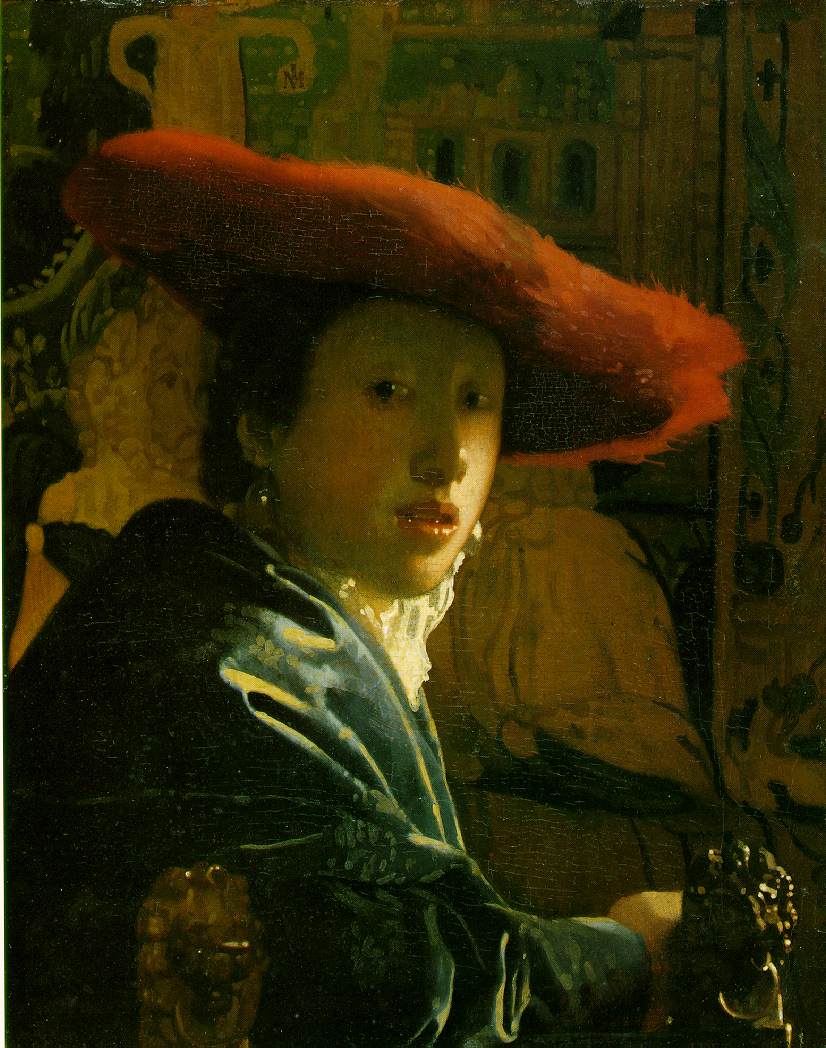
But the real fascination of this story is not so much that van Meegeren was able to produce forged Vermeers that fooled everyone; it's that the Vermeers he produced look nothing like real Vermeers. For example, these two paintings are legitimate Vermeers, the Geographer and the Girl with the Red Hat:


This is van Meegeren's Supper at Emmaus:

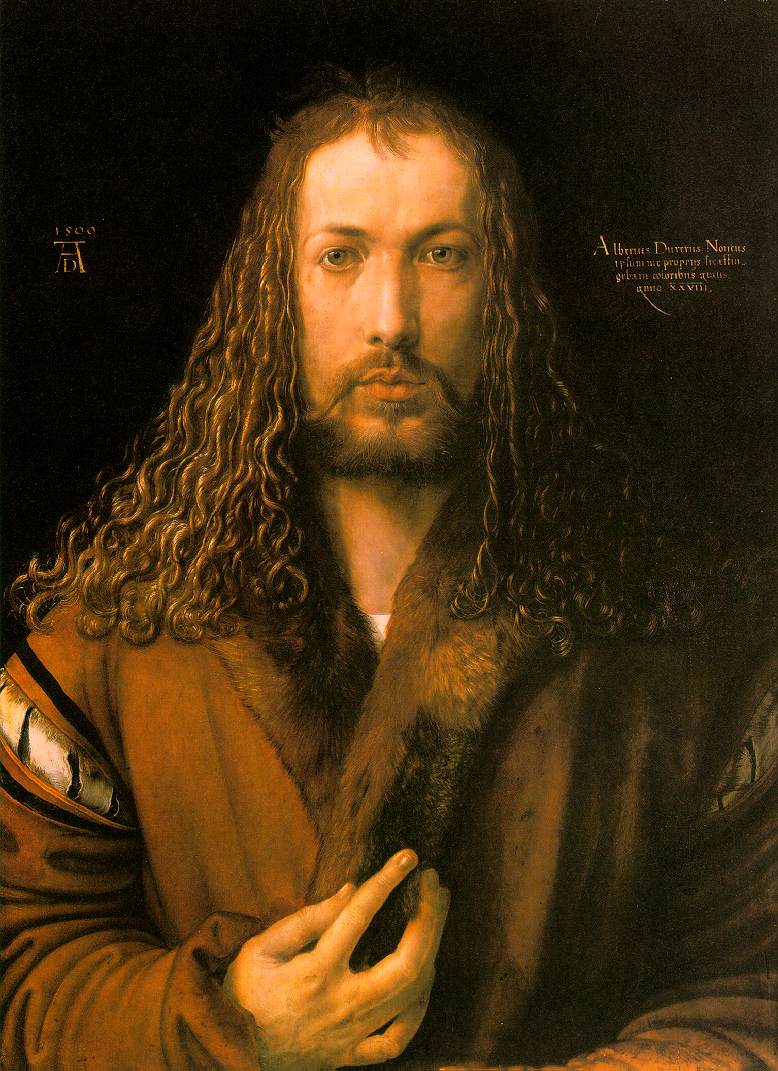
Not for a second would anyone today think that the same artist painted that third image as the other two, and yet this fooled everyone. Lopez' most interesting argument was that fakes rely on subliminal references to contemporary culture that make the picture oddly resonant to the viewer and thus more likely to accept it; however, after a few decades (he suggested 40 years is the timeline) the power of those contemporary references has faded, leaving people surprised that anyone could have been tricked all those years ago. In the case of this painting, Lopez traced its relationship to the style of volkisch painting being promoted in Nazi Germany, of which the Dutch van Meegerem was a huge supporter (he sent Hitler a note in 1942 thanking him for doing such a good job. Seriously. It was in Lopez' slideshow), as well as the resemblance between the facial physiognomy of Christ here and Albrecht Durer's famous Self Portrait:
Durer was enthusiastically held up as the paragon of "good" German art by the Nazis, and they had specifically identified his physiognomy as the "ideal" Germanic face. Thus, by incorporating those elements into his completely fake painting, van Meegerem made it subtly more attractive to his contemporaries, who were already "used to" seeing paintings that looked like this.This is only a small fraction of Lopez' argument, both about this painting and about van Meegeren's forgeries in general, but it was really fascinating to listen to.
Thursday, November 11, 2010
Still Life
The location of the painting itself is a mystery, but the fact that it was identified as a Caravaggio in the early 19th century, when his reputation was basically in the gutter (he wouldn't be catapulted to the megastardom through which we know him today until a historic exhibition in Milan in 1951) suggests that it was a secure attribution. Only one independent still life by Caravaggio is known today, this incredibly illusionistic work of 1599 (it's like you could reach out and stroke the wicker of that basket!):
Yet we know he painted more of them--and one of them, it seems, found its way to Philadelphia and had an impact on Peale, a member of a prominent family of Philadelphia artists.
Now, I'm not usually a big fan of still life. Caravaggio's marvelous little picture is an exception to this rule, on account of its general awesomeness, but in general, blech. Dutch still life, in particular, is probably the genre of Western art I like least.
I know they're full of hyper-specific symbolism and they constitute warnings about vanitas, but I just find them so. damn. ugly. My friend knows all this, so she was teasing me in advance about how I would probably be bored to tears by her paper, but to my surprise, I really enjoyed not only her argument, but the images as well. Don't Peale's blackberries look good enough to eat? She also showed this late 16th century drawing of irises by a Florentine naturalist named Ligozzi (not technically a still life, but it's still something I'm not usually intrigued by):
I have a fondness for irises, so this really struck me as lovely. However, I remain resolute in my hatred of Dutch still life. Gah.
Tuesday, November 02, 2010
Fun with Professors
Apparently, the recent retirement of her mentor at Bryn Mawr caused her to re-evaluate her attitude toward students (well, not all students. A few select students. Us, basically.) She told us last night that her mentor never showed any fondness for her students until they completed their PhDs, at which point she suddenly started signing her emails "Love, Dale." Dr. Bolman told us she had this epiphany where she realized she didn't have to be like that and didn't want to be. So, voila--we got to visit Dr. Bolman's fabulous apartment.
The building was old, completely modernized except for some cool features like the 20-foot ceilings, exposed wooden beams, and original dark wood floors (the nails had square heads, which was interesting). She has more books than I have ever seen in anyone's personal collection. Her office was lined with bookcases, her hallway was lined with bookcases, the living room was lined with bookcases! It was pretty incredible. It was also decorated in a really cool fashion, which I don't think I can really describe, and her furniture rocked. Like, a ridiculously comfortable leather couch that also incorporated a chaise longue--from Ikea, although I never would have thought so (apparently they do have 'higher end' furniture." There's an odd sense of intimacy in being in a professor's home and putting your coat and bag down in her bedroom, or using the bathroom and seeing all her makeup. Jasmine and I agreed on the ride home that at first it was a little bit awkward, because we weren't quite sure what to say (we wound up talking about school, naturally). Luckily there was wine to drink and cheese to nibble on.
We had invited her to join us for the movie, and she accepted, so off we went in the cold to see "Hereafter," which we were expecting to be a sad movie. Dr. Bolman announced herself as a crier and made us promise that if she cried we wouldn't tell anyone, but in the end it wasn't really a crying kind of movie. There were some sad bits, but none too heart-wrenching, and the ending was happy in a contrived sort of way. I don't think I'd really recommend it to anyone else, it was fine, but nothing special. Anyway, after that we went to a Persian restaurant near Dr. Bolman's apartment for takeout, to which she treated us, using her "voice of command," as she called it, on Jasmine when she seemed about to insist on contributing. That was pretty hilarious, especially the way Jasmine immediately obeyed and sat down. Then we went back to her apartment to eat. As we were getting plates I noticed that among the items on her fridge were two magnets of Bella and Edward from Twilight. WTF?
We did wind up having an interesting discussion about psychics and talking to the dead (Matt Damon plays one in the film). I asked if the others would consult one. Dr. Bolman told us that twenty years or so, she used to visit a psychic regularly! (I managed not to let my mouth fall open, but it was a close thing). She said that she was looking for some kind of confirmation that there was something else out there, some other dimension, and she would go to this woman who claimed to read auras and tell you vague things about your future. She could also tell you things about people in photographs if you brought them in; Dr. Bolman said she was thoroughly convinced by this woman's ability to accurately describe people she had never met and only seen in a photograph, and that the vague predictions about her future always came true, but she realized ultimately that it was drawing too much of her attention and money, so she stopped going.
Jasmine said she wasn't sure if she would consult a psychic, Agnes said probably not. I told them about how my mom consulted a psychic on her birthday once and was quite convinced--the person told her she saw a red-headed woman who wanted to know if my mom was still angry at her (she was) and a large man with a breathing problem (my dad had sleep apnea), who wanted her to know that he was OK. I said that I wasn't sure either, partially because I'm a skeptic and I don't believe in life after death, and partially because I don't feel the burning need to talk to my parents. I mean, what would I say to them? I miss you? Duh. And what would I want to hear back, that they're fine, that they're proud of me, etc? Since I don't believe in an afterlife of any variety, I'm not concerned about them being "fine," and I know they were proud of me. I think trying to communicate with them, even if it were possible, would just be more painful than it'd be worth. Jen, on the other hand, would leap at the chance, I'm sure (in fact, I'm shocked she's never done it). However, even though I don't believe in the afterlife, I'm not completely skeptical about psychics. I mean, we only use a fraction of our brain power, so who's to say what could be possible for people who can somehow access the rest? After all, we only perceive time as completely linear; maybe they do catch glimpses of the future.
We also wound up discussing our favorite works of art. I was surprised to learn that Dr. Bolman's favorite was Simone Martini's Annunciation in the Uffizi (she's a Byzantinist/Coptic specialist, so I thought it'd be something there). Agnes' favorite was a painting from the Waddi Natrun site she's worked on in Egypt. Jasmine's favorites are two Saint Cecilias: Raphael's painting, and Stefano Maderno's statue. I had serious trouble thinking of favorites; in the end I said El Greco's View of Toledo, and Canova's statue of Pauline Bonaparte in the Borghese.
Anyway, we had a really fun time last night. I heart Dr. Bolman!